How AI Footwear Try-On Converts Return Rates Into Revenue


In this article, you will learn how the economics of footwear returns impact your profit margins, how AI shoe fitting technology closes the confidence gap for customers, and how investing in these tools generates a measurable Return on Investment (ROI) through improved operational efficiency and conversion rates. The following sections will examine the financial reality of returns, the mechanics of AI styling, and the revenue opportunities that arise when you solve the fit problem.
Introduction
Selling shoes online poses a financial challenge that other retail sectors do not face to the same degree. While apparel retailers struggle with fit, footwear retailers deal with complexity due to the stiff structure of shoes and the movement of the human foot. For years, store owners and brand managers have relied on static styles and lenient return policies to fix the difference between digital images and physical products. However, these traditional methods shift the fit risk onto the customer, and this strategy causes unsustainable financial consequences.
If you manage a footwear brand or an e-commerce platform, you likely see returns as a frustrating cost of doing business. But in the current economic climate, returns are not just a logistics problem, they are a primary source of lost revenue that threatens profits. You will continue to sacrifice margins even as you grow your sales if you don't address styling uncertainty, which is the main cause of these returns.
You must prevent returns to solve this revenue leak. AI footwear try-on technology has evolved from a marketing novelty into an operational tool. This technology analyzes customer data to predict style fit, which reduces return rates and protects profits.
True Cost of Styling Uncertainty
Most retailers track return rates as a standard metric, but few calculate the total cost of every returned pair of shoes. The cost extends beyond the refunded revenue when a customer returns a product. You must also account for the operational costs that you can't recover.
According to a 2025 study on e-commerce trends, footwear returns average 18%, a figure that sits just behind the apparel category. For a mid-market retailer making $1 million in annual footwear sales, this rate means approximately $180,000 in gross revenue flows back out of the business. However, the true cost is higher. Processing returns, which includes shipping, warehouse labor, and restocking, often costs between $10 and $20 per pair. If the shoes can't be resold as new, which is a fate that befalls 20-30% of returned goods, you also face inventory write-offs.
This money is lost because customers lack the tools to decide confidently. When customers can't determine how a shoe will look on them, they resort to "bracketing." This practice involves buying the same shoe of a different style with the intention of returning the ones that don't fit.
Bracketing is a rational behavior for a customer who faces uncertainty, but it destroys a retailer's margins. It makes inventory unavailable, ties up stock that could be sold to other customers, and guarantees a return rate of at least 50% for that order. If you want to protect your margins, you must provide a way for customers to visualize style fit without the physical product.
Bridging the Confidence Gap with AI
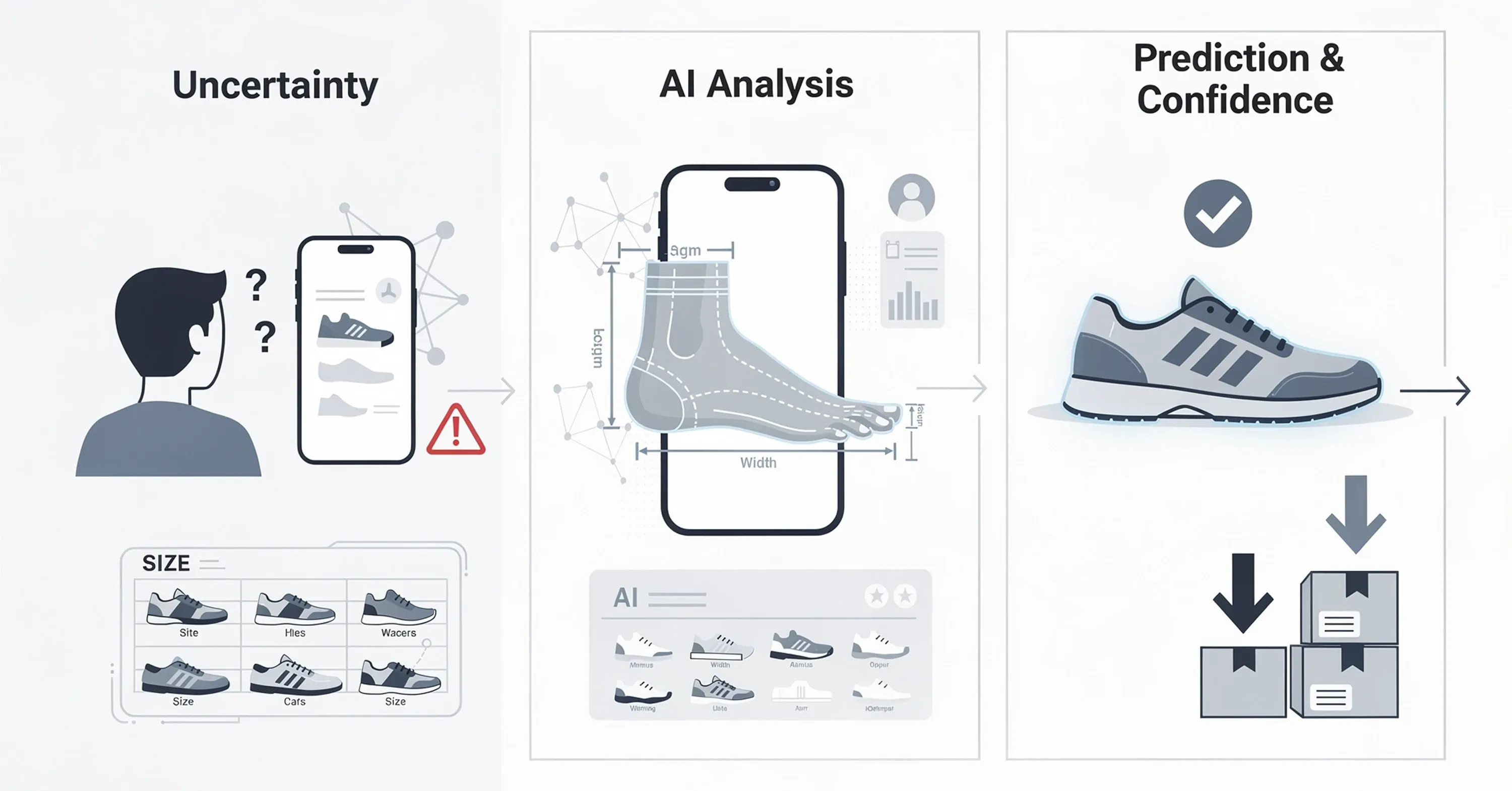
To stop bracketing and returns, you must resolve the customer's hesitation. Recent data indicates that 72% of consumers hesitate to buy shoes online because they are unsure about the style. This hesitation creates a "confidence gap" that results in either a lost sale or a high-risk purchase that is likely to come back.
AI footwear try-on technology closes this gap by providing data-driven recommendations rather than generic estimates. Unlike a static chart, AI fitting tools use computer vision and machine learning to analyze the customer's foot geometry. By using a smartphone camera, a customer can scan their feet to capture measurements. The AI then compares this biometric data against the inside dimensions of the shoe model the customer is viewing.
This process moves the experience from a guess to a prediction. For instance, platforms like SafeSize have implemented 3D foot scanning and recommendation engines that have led to a 21% drop in return rates. When customers trust that the recommendation relies on the shoe's design, they feel confident enough to buy a single pair.
Furthermore, these tools often use past purchase data to refine recommendations. If a customer kept a pair of blue Nike running shoes but returned a pair of red Adidas trainers, the AI learns from this behavior. It understands what style the customer prefers, and applies that preference to future recommendations. This level of personalization exceeds what manual customer service can offer, and it prepares the customer to buy.
Increasing Conversion Rates
While reducing returns defends your profit, AI styling technology also drives revenue growth by improving conversion rates. The footwear sector struggles with low conversion rates compared to other fashion categories. The median conversion rate for footwear is roughly 2.2%, which is lower than the rates for accessories or general apparel. This difference exists because customers think buying shoes online is risky.
When you remove that risk, customers are more likely to complete the checkout process. Product pages that feature virtual try-on visuals achieve more than a 25% increase in conversions compared to pages that display only standard product images. The logic here is simple. When a customer can visualize how the shoe looks on their foot, the friction in the buying process disappears.
Advanced visualization tools, such as 3D shoe models, improve this effect. These models allow customers to rotate the shoe, zoom in on textures, and see how materials might flex or crease. Generative AI has advanced to the point where these interactions look photorealistic, mimicking fabric drape and material behavior. This sensory information mimics the in-store experience, which helps the customer build an emotional connection with the product.
Real-world applications confirm these metrics. For example, Clinique reported that customers who engaged with its AR-powered virtual try-on experience were approximately 2.5X more likely to make a purchase and also had about a 30% larger average order value compared to customers who did not use the AR feature. This demonstrates a substantial conversion lift directly tied to the technology. This kind of increase can significantly impact revenue even before accounting for the additional savings from reduced returns or increased customer engagement.
Improving Operational Efficiency
Implementing AR shoe styling solutions also improves your daily operations regarding customer service. Styling questions consume a lot of time for support teams. Customers email, chat, or call to ask how a shoe compares to a brand they already own.
Answering these repetitive questions costs money. AR try-on technology can reduce style-related customer service inquiries by up to 30%. For a store processing 50,000 monthly orders, this reduction can save thousands of dollars in labor costs every month. When your support staff spends less time answering basic styling questions, they can focus on high-value interactions, such as resolving complex shipping issues or helping with styling advice.
Moreover, the data generated by these AI tools provides insights for your buying and merchandising teams. If the AI data reveals that customers return a model because it is too dark, your merchandising director can adjust future orders or work with the manufacturer to correct the style. This feedback loop allows you to curate an inventory that aligns better with your customer base, and can lead to fewer markdowns and healthier margins over time.
Retailers often worry about the technical burden of adding these tools, but modern solutions integrate with platforms like Shopify or WooCommerce. Cloud-based Application Programming Interfaces (APIs) allow you to deploy styling widgets without overhauling your IT systems. With timelines to implement often ranging from two to eight weeks, the disruption to your operations is minimal compared to the efficiency gains.
Building Customer Lifetime Value
AI footwear try-on builds customer loyalty. Customer acquisition costs continue to rise, so your profitability depends on your ability to retain existing shoppers. Trust is the currency of retention in the footwear industry. If a customer buys a pair of boots from you and they fit out of the box, that customer trusts your brand.
This trust increases Customer Lifetime Value (CLV). Customers who use fitting tools and experience a good outcome are more likely to return for their next purchase because they know they can rely on the fit. Data shows that providing accurate styling information leads to repeat purchases. Conversely, a bad fit experience often results in a lost customer. If a new customer has to go through the hassle of printing a label, repacking a box, and waiting for a refund, they are unlikely to shop with you again.
Furthermore, as younger demographics like Gen Z become the dominant spending force, they expect these conveniences. They view personalized, tech-enabled experiences as a standard part of shopping, not a bonus. Retailers that fail to offer these tools risk looking outdated and less convenient than competitors who do.
By treating fit as a data science problem rather than a customer service issue, you create a smoother experience that encourages loyalty. A customer profile that stores 3D foot data allows for instant recommendations on all future visits. This ensures that a customer stays into your ecosystem.
Final Points
The financial case for AI footwear try-on is clear. Returns drain profitability and this costs retailers millions in logistics, labor, and lost inventory value. Traditional styling methods fail to solve this problem because they don't account for the complexity of foot mechanics or the variability of shoe manufacturing.
To sum up, implementing AI styling technology addresses these challenges.
-
First, it reduces return rates by 20% to 40% by helping customers choose the right style before they buy.
-
Second, it increases conversion rates by removing the hesitation that stops shoppers from clicking "buy."
-
Third, it improves operational efficiency by automating styling support and reducing the labor required to process returns.
If you want to protect your margins in a competitive market, you must stop viewing returns as a cost. Instead, view styling technology as a source of revenue. By investing in AI footwear try-on, you provide the clarity your customers need and the efficiency your business requires. The technology is available, the ROI is proven, and the market is moving in this direction.
Now is the time to audit your current return rates and explore how AI can turn those lost dollars into retained revenue.
Frequently asked questions
Quick answers to the questions teams ask most about this topic.
Footwear is uniquely difficult to sell online due to the rigid structure of shoes and complex foot mechanics. Unlike apparel, which can stretch, a shoe that is slightly off in arch height or toe width becomes unwearable, leading to an average return rate of 18%.
Bracketing is when a customer buys the same shoe in multiple sizes (e.g., 9, 9.5, and 10) because they are unsure of the fit. This practice is a "margin killer" for retailers because it ties up inventory and guarantees a return rate of at least 50% to 66% for that specific order.
AI fitting tools use computer vision and machine learning to analyze a customer's biometric foot data via a smartphone camera. Platforms like WEARFITS allow customers to scan their feet and compare the results against the precise internal dimensions of a shoe, turning a "guess" into a data-driven prediction.
Yes. Removing the "confidence gap" significantly reduces buyer friction. Research shows that product pages with virtual try-on features can see a 25% increase in conversions, with some brands reporting that sales have doubled compared to using standard 2D images.
Modern AI solutions are designed for rapid deployment. Most tools offer cloud-based APIs or plugins for popular platforms like Shopify and WooCommerce, allowing retailers to implement a digital fitting room in as little as two to eight weeks without a major IT overhaul.