Gen AI Virtual Try-On Trust: How to Win Shopper Confidence

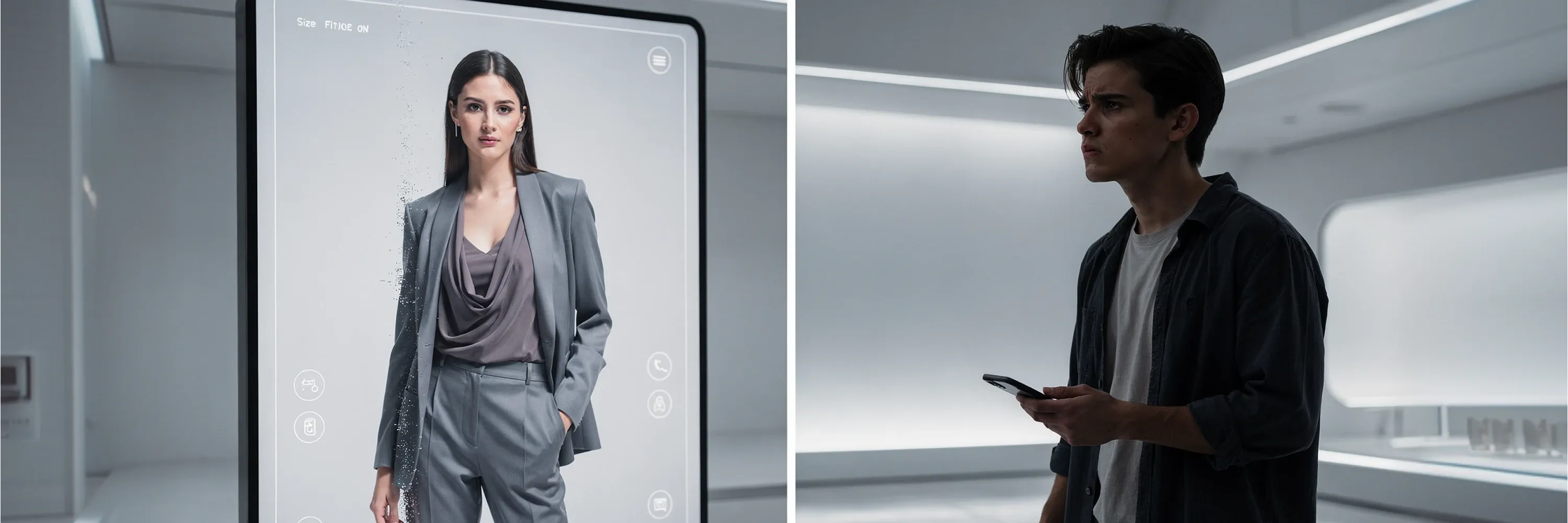
Short answer: shoppers like Gen AI virtual try-on but rarely buy from it, because they doubt what it shows about their own bodies, hesitate to share photos and measurements, and feel misled when personalized fitting turns out to be a generic avatar. Brands earn trust by labeling AI-generated images openly, showing honest visuals instead of synthetic perfection, explaining how personal data is handled, and being clear about which garments the technology renders well (solid-color, standard garments) and where it still struggles (complex prints and logos).
In this article, we examine the gap between technical advancements and consumer adoption for digital clothing models. We analyze the behavioral barriers that cause shoppers to distrust these systems and explore how transparency can ultimately change online retail.
Gen AI virtual try-on and trust gap fashion E-commerce has not yet closed
Fashion retailers have cycled through virtual fitting technology for years. Zara deployed AR displays across 120 stores, ASOS launched its "See My Fit" feature to show garments on diverse body shapes, and H&M followed with AI-powered fitting tools. Yet most of these initiatives failed to become habitual parts of the shopping journey.
Gen AI virtual try-on represents a technically superior generation of the same idea, with physics-based fabric simulation and generative AI producing garment visualizations that earlier systems could not achieve. Yet the behavioral problem remains unsolved. Virtual try-on is the most desired AI shopping feature, with 77% of online shoppers wanting e-commerce retailers to offer this technology, but actual usage rates across deployed implementations remain far lower.
Apparel shows a 25% return rate while the average eCommerce return rate reached 16.9% in 2024, suggesting that even where Gen AI virtual try-on tools exist, shoppers are not relying on them to make more confident purchase decisions. The gap is not an engineering problem. It is a trust problem, and this article examines why it persists and what retailers must do differently to close it.
Technical reality of modern E-commerce
The gap between practical digital clothing models and shopper usage becomes obvious in the technical reality of modern e-commerce. Mid-to-large retailers now treat digital fitting as operational infrastructure rather than a novel experiment. Retailers deploy physics-based simulation and digital twins to deliver highly accurate garment renderings. Their systems calculate fabric drape, stretch, and movement across different body types.
We candidly assess that the engineering works. Gen AI virtual try-on creates accurate visual representations that solve the distortion problems of earlier iterations. However, technical capability outpaces consumer trust. We recognize that an objective measurement of success requires more than just high adoption rates among brands. Shoppers must actually use these tools. While AI-powered virtual fitting technology produces mathematically precise images, it struggles to change consumer behavior during the checkout process.
Shoppers admire the visuals but rarely rely on them to make purchase decisions. Retailers track high engagement times but see low conversion rates from these specific features. Brands must understand shopper hesitation if they want to convert a feature into a shopping habit. This gap between engineering success and behavioral adoption forms the core challenge in modern retail.
Algorithm improvements will not fix the trust deficit. Engineers build precise lighting models, but consumers still abandon their shopping carts. The fashion industry needs to address this behavioral friction before investing more capital into visual upgrades.
History of digital fitting room failures
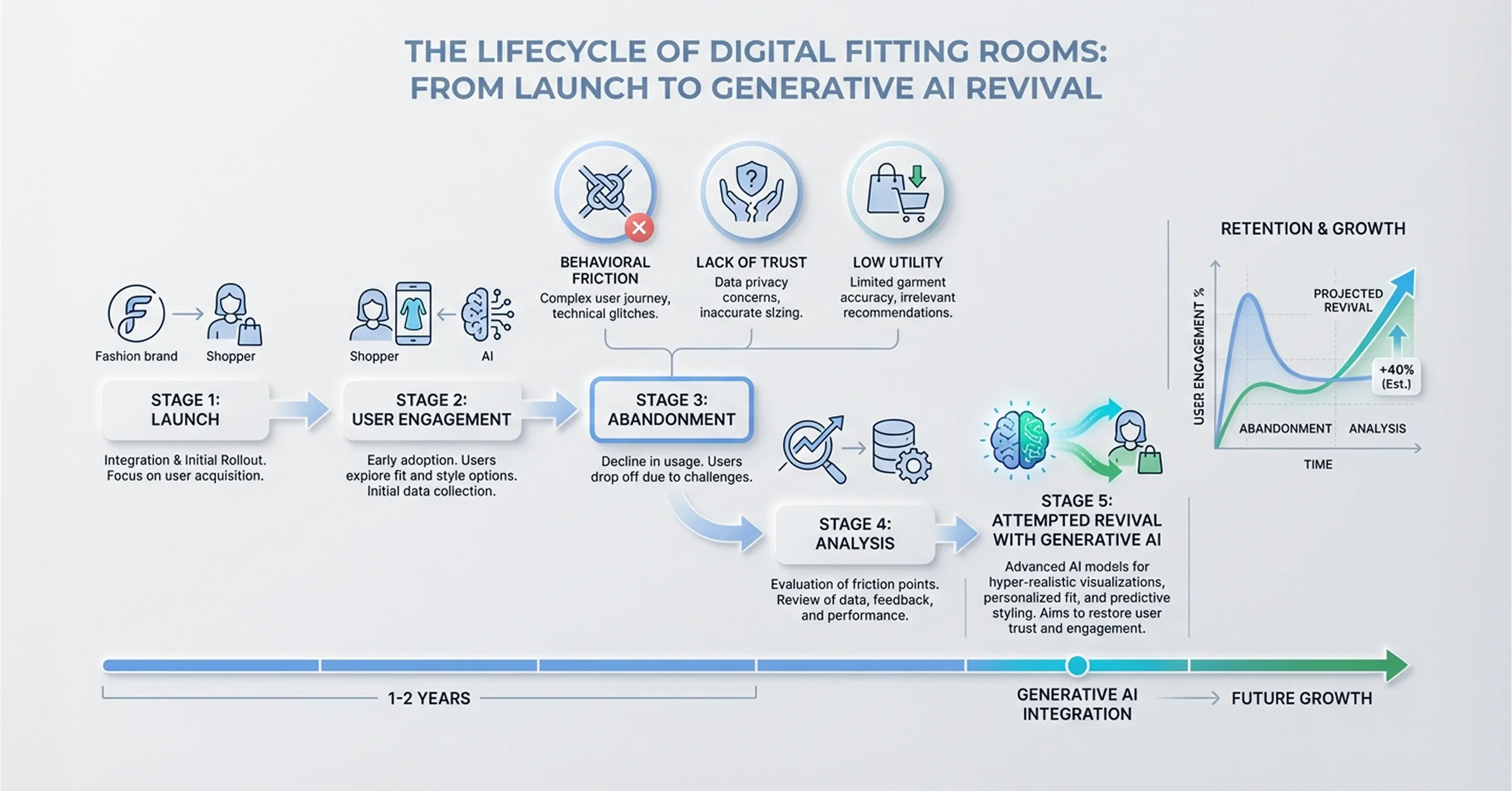
This behavioral friction caused a clear pattern of discontinued digital fitting rooms over the past two decades. Major fashion brands launched virtual fitting initiatives with substantial fanfare and quietly removed them from their core retail operations a year or two later.
Earlier systems failed because friction was high and utility was low. Shoppers never developed behavioral trust in those tools. Today, brands attempt to revive this concept with generative AI product fitting. Current approaches solve the distorted garment rendering and handle diverse body types much better.
A straightforward look at the retention data shows a familiar warning sign. Users engage briefly with the novelty and then abandon the feature entirely. We must examine the specific friction points that still exist to understand this abandonment. Retailers must complete three essential steps to prevent history from repeating itself:
-
Analyze why previous virtual try-on deployments lost daily active users after the initial launch phase.
-
Measure whether shoppers return to use the digital fitting room for their second and third purchases.
-
Evaluate if the current generation of Gen AI solves the behavioral adoption problem alongside the technical rendering problem.
If these tools do not earn consumer confidence, even the most advanced systems risk suffering the same fate as their predecessors. Shoppers need a reliable tool instead of another digital novelty.
What shoppers truly believe about Gen AI virtual try-on
To build a reliable tool, the industry must understand what shoppers truly believe about digital clothing models. We see a sharp contrast between what shoppers say they want and what they actually use. Survey data consistently shows high consumer interest in digital fitting features. Yet, actual usage rates remain low across the industry.
The trust question goes beyond whether shoppers believe Gen AI can accurately render a piece of clothing. The real issue centers on whether shoppers trust what these systems show them about their own bodies. Consumers hesitate when a system asks for personal photos and exact body measurements. They worry about data privacy and accurate representation.
A systematic review of 69 VTO research studies confirms that personalized scanned avatars, while effective at enhancing body ownership, also raise significant privacy concerns that directly reduce adoption intention. Shoppers struggle to distinguish between genuine product photography and synthetic outputs. This confusion makes them doubt the fit and fabric of the garments they want to buy.
If they cannot trust the image on the screen, they will not proceed to checkout. They prefer to buy from brands that use clear and traditional photography. The fashion industry assumes that consumers want maximum immersion, but the data suggests that consumers prioritize clarity and honesty over synthetic perfection.
Gap between interest and generative AI product fitting
This preference for clarity and honesty highlights a significant gap between consumer interest and actual generative AI product fitting features. Shoppers frequently state they want digital fitting features, but they rarely encounter them in a standard shopping journey. Many brands restrict digital fitting to specific product categories or isolated mobile applications.
This fragmentation prevents shoppers from developing a consistent habit. Furthermore, retailers create a massive promise-reality gap in the market. Retailers often promise personalized fitting experiences but deliver generic avatars with minor size adjustments. The resulting experience creates frustration instead of adoption when consumers discover this discrepancy. They feel deceived by the marketing claims. We observe that shoppers abandon the purchase entirely when a system fails to honor its promise of true personalization. Retailers lose credibility when their marketing outpaces their execution.
Uncanny valley in personal representation
Execution failures often occur when developers prioritize visual perfection over natural representation. Photorealistic accuracy can paradoxically reduce purchase confidence. As visual representations become more lifelike, they enter the uncanny valley. Shoppers look at an avatar that resembles them but moves or stands unnaturally. This slight distortion makes them deeply uncomfortable.
The industry rarely addresses this uncanny valley phenomenon openly. Instead, developers push for higher resolutions and sharper textures. They assume that better graphics will automatically yield better conversion rates. However, when AI-powered virtual fitting technology generates an image that looks almost real but feels slightly off, shoppers lose their genuine connection to the product. They focus on the visual flaws of the avatar rather than the fit of the garment. This discomfort overrides their desire to buy the clothing.
Paradox of disclosure
Brands can reduce this discomfort and increase purchase desire through clear disclosure. Many retailers fear that labeling synthetic images will reduce conversion. The evidence points in the opposite direction. Disclosure labels actually increase trust. Shoppers appreciate the honesty when brands openly acknowledge their use of synthetic product fitting. Transparency provides an authentic foundation for the customer relationship.
Forward-thinking retailers like Zara and ASOS have begun disclosing their use of AI-generated imagery within their brand narratives rather than concealing it in terms of service. This transparency-forward approach builds confidence because shoppers know exactly what they are seeing.
Regulatory pressure is accelerating this trend globally. Article 50 of the EU Artificial Intelligence Act requires providers of generative AI systems to ensure that AI-generated content is marked in a machine-readable and detectable format. Under the Act’s timeline, these transparency obligations apply from August 2026.
Smart retailers view these transparency requirements as a competitive advantage rather than a compliance burden. A realistic assessment shows that undisclosed synthetic generation only damages loyalty when consumers inevitably discover it. Honest communication turns a potential privacy concern into a strong selling point for the brand.
Where capabilities actually succeed with Gen AI Virtual Try-On
Accurate representation on real bodies requires an honest look at where current technology succeeds and fails. Solid-color, standardized garments render with high fidelity. When shoppers test these basic items, the fit accuracy meaningfully reduces return rates.
However, garment diffusion models can struggle with complex patterns, such as floral prints, geometric designs, and branded logos. The architecture produces a pattern similar to the original, but it does not provide pixel-accurate representation. This flaw affects the exact category of statement pieces that often drives purchase decisions.
Earlier Gen AI virtual try-on systems required several seconds per image generation, a delay that frustrated shoppers expecting real-time feedback. Generation speeds continue to improve as infrastructure scales, but latency remains a friction point on mid-range devices. Furthermore, we face an honest reckoning about the types of returns these tools prevent because AI-powered virtual fitting technology changes how buyers evaluate clothing:
-
They reduce fit-related complaints because the visual proportions match their expectations.
-
They increase feel-related returns when the physical garment weight differs from the digital drape.
-
They question complex patterns when the delivered item lacks the geometric alignment shown online.
Brands that implement Gen AI virtual try-on often celebrate return reduction statistics. Yet, these statistics might reflect selection bias among already-confident customers who buy simple items. Footwear fitting tools handle rigid structures well, but soft apparel remains computationally demanding to render with full accuracy.
Trust architecture
Even when systems render apparel accurately, technical precision holds no value if data anxiety acts as an adoption barrier. Shoppers refuse to submit the required personal inputs, and this causes the most sophisticated algorithms to fail. Research confirms that 42% of virtual try-on users express hesitation about sharing personal measurement and body data with retailers.
When a system asks for precise body sizing information, shoppers worry about how that data is stored, used, and potentially shared. This hesitation does not distribute evenly across all buyers. A systematic review of VTO adoption studies consistently documents that women express higher levels of privacy concern and body image anxiety when interacting with synthetic representations of themselves than men do, a pattern that directly impacts how brands should design their shopping experiences. A transparent approach helps retailers bridge this gender trust gap.
Unacknowledged algorithmic failures further damage consumer confidence. When a generative AI product fitting tool confidently shows a fit that does not exist in reality, customers blame the brand instead of the underlying model. Companies protect their reputation and reduce online product returns when they offer clear disclosures about system limitations alongside the experience itself. Trust functions as a behavioral metric that grows through consistent alignment between what a system promises and what it actually delivers.
Conditional path to modern online retail
This consistent alignment builds a conditional path to modern online retail. A fully modernized e-commerce environment will not emerge through a single inflection point. Brands will adopt Gen AI virtual try-on category by category as they earn enough repeated trust to change shopping habits. The leaders in this space treat trust architecture as a product requirement alongside technical performance.
Conversational shopping agents represent the next logical evolution in online retail. AI-powered virtual fitting technology will no longer function as an isolated feature on product pages. It will embed itself within shopping assistants that guide discovery, calculate sizing, and finalize purchases within a single interaction. Successful approaches require brands to adopt rigorous practical criteria for evaluating trust-ready implementations.
They rely on accurate three-dimensional assets that originate from actual product photography rather than synthetic approximations. They also maintain open communication about how the system calculates fit and handles personal data. If a retailer hides the limitations of complex garment categories, shoppers will eventually discover the gap and abandon the platform entirely. Transparency builds a reliable foundation for long-term customer relationships.
The true change relies on behavioral shifts rather than algorithmic milestones. Companies that dominate the next decade of online retail will prioritize honesty over synthetic perfection. They will build systems that respect customer boundaries and deliver undeniable utility.
Conclusion
The technical progress in digital fitting has already happened, and the search for better algorithms will not determine whether shopping behavior actually changes. Companies that build the most honest systems will define this space in the next five years and surpass those that build the most impressive systems.
Honesty about what a system can and cannot do acts as a measurable competitive advantage. WEARFITS uses Gen AI technology to build transparent and accurate digital fitting experiences that do not require complex 3D modeling. We encourage retailers to try our Gen AI virtual try-on upload for product catalogs.
Frequently asked questions
Quick answers to the questions teams ask most about this topic.
You don't need a special phone because most modern smartphone cameras handle this technology well. Standard lenses capture enough detail to map your body shape. You just need a clean lens and a steady hand to get the image for the system.
You can integrate Gen AI virtual try-on features into your shop with WEARFITS. This technology company provides a 2D-to-3D converter that transforms standard product photographs into 3D models. The system works from studio product photographs, so you can skip expensive manual 3D modeling.
It depends on the retailer. Privacy laws such as GDPR limit how long companies may keep personal data and for what purpose, so check the store's privacy policy for its retention rules.
Your phone browser doesn't always allow camera access and restricts memory for graphics. Operating systems limit how much processing power websites can use to protect your battery life. You can fix this issue if you update your browser or clear your temporary internet files.
You should face a window that provides natural daylight to get the best results. Overhead room lights often cast dark shadows that confuse the mapping software. Even lighting across your body helps the system calculate your proportions and create a better digital fit.