Photo-to-3D vs. Gaussian Splatting: Which technology is better for footwear Virtual Try-On?

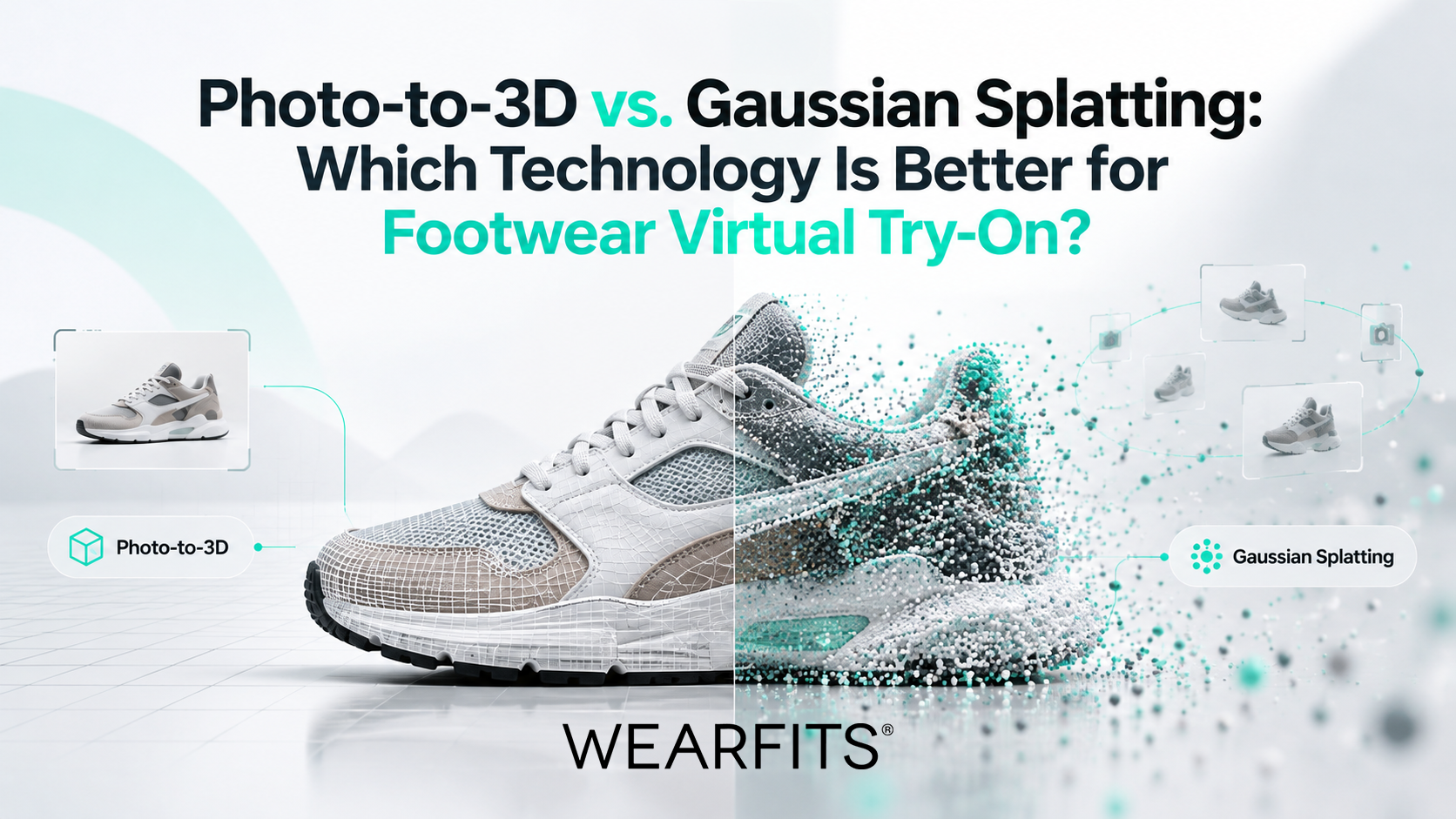
As online footwear shopping becomes increasingly interactive, augmented reality (AR) virtual try-on is changing how customers discover and evaluate shoes. Instead of relying exclusively on product images, shoppers can use their smartphones to visualize footwear directly on their feet, explore designs from different angles, and make more informed purchasing decisions.
For footwear brands, this technology creates opportunities to improve customer engagement, build purchasing confidence, and potentially reduce returns related to appearance expectations.
However, an effective virtual try-on experience depends on more than accurate foot tracking. Behind every realistic digital shoe is a 3D asset that must balance visual quality, loading speed, and mobile compatibility.
Two technologies frequently appear in discussions about creating these assets: Photo-to-3D and 3D Gaussian Splatting (3DGS).
Although both can use photographs to produce three-dimensional visualizations, they serve different purposes and offer distinct advantages.
At WEARFITS, we develop AI-powered virtual try-on solutions designed for practical e-commerce applications. In this guide, we examine how Photo-to-3D and Gaussian Splatting compare in terms of image requirements, photorealism, asset optimization, processing time, and real-time footwear AR.
Understanding Photo-to-3D and Gaussian Splatting
Before comparing these technologies, it is important to clarify one essential distinction: Photo-to-3D describes a digitization workflow, while Gaussian Splatting is a method of representing and rendering 3D content.
This means they are not necessarily competing technologies.
What Is WEARFITS Photo-to-3D?
Photo-to-3D refers to converting ordinary two-dimensional photographs into three-dimensional digital models.
Using artificial intelligence, computer vision, and reconstruction techniques, a Photo-to-3D system analyzes product images to estimate an object's geometry, surface details, colors, and textures.
For footwear retailers, this approach makes it possible to transform existing product photography into interactive 3D shoes without manually building every model in specialized 3D software.
The WEARFITS Photo-to-3D platform demonstrates this process by converting shoe photographs into textured GLB models that can be used in augmented reality experiences.
What Is Gaussian Splatting?
Gaussian Splatting is a rendering technique introduced in 2023 by researchers whose work was presented at SIGGRAPH.
Rather than constructing objects primarily from connected polygons, this method represents visual information using numerous three-dimensional Gaussian primitives.
Each primitive stores properties such as position, orientation, scale, transparency, and color information.
Together, these elements recreate the appearance of an object or scene from different viewpoints.
As explained in the original 3D Gaussian Splatting research paper, the technique enables highly detailed novel-view rendering while supporting real-time visualization under suitable hardware conditions.
For footwear e-commerce, the more useful comparison is between AI-generated textured 3D meshes and Gaussian Splat assets.
1. Product photography and 3D capture requirements
One of the most important considerations for footwear brands is how much effort is required to digitize each new product.
This becomes especially relevant for retailers managing hundreds of styles, colors, and seasonal collections.
Photo-to-3D: Working with existing product images
Modern AI-powered Photo-to-3D systems can reconstruct footwear using relatively few photographs.
For example, the WEARFITS workflow supports uploading one to four product images, preferably showing the shoe from different perspectives.
AI analyzes the visible product features and estimates the three-dimensional structure, reducing the need for complex scanning equipment or extensive manual modeling.
This approach can fit naturally into established e-commerce photography processes.
Brands can often reuse existing catalog images or supplement them with additional angles where necessary.
As described in the WEARFITS Photo-to-3D documentation, users can generate a 3D shoe model and access an AR preview through a browser-based workflow.
Gaussian Splatting: capturing more visual information
Traditional Gaussian Splatting reconstruction typically benefits from a much denser collection of overlapping images.
Depending on the object's complexity and the desired quality, this may involve dozens or more photographs or a carefully recorded video sequence.
Consistent lighting, sufficient overlap, and reliable camera-position estimates are particularly important.
Reflective surfaces, inconsistent illumination, and missing viewing angles can introduce reconstruction artifacts.
For footwear brands, collecting these images may require additional photography time and controlled capture procedures.
The key difference: Photo-to-3D mesh workflows generally offer a simpler path from existing product photography to deployable 3D assets, while traditional Gaussian Splatting often requires more extensive visual input.
2. Visual realism and footwear material quality
Shoes present a demanding challenge for 3D reconstruction.
A single product may combine smooth leather, suede, knitted fabric, reflective metal, translucent rubber, and detailed stitching.
Both mesh-based reconstruction and Gaussian Splatting can produce impressive results, but their strengths differ.
Gaussian Splatting and photorealistic appearance
Gaussian Splatting is particularly effective at reproducing intricate visual appearances, including view-dependent lighting effects.
Its representation can preserve subtle color changes, surface reflections, and details captured from multiple camera angles.
This makes it attractive for presenting glossy leather shoes, metallic details, and visually complex materials.
For premium product visualizations, Gaussian Splatting can deliver convincing realism without requiring every material property to be manually recreated through conventional shaders.
However, excellent photographic appearance does not automatically guarantee precise geometric boundaries.
Thin shoelaces, sharply defined sole edges, and other delicate structures may reveal floating artifacts or softness when reconstruction quality is insufficient.
Photo-to-3D meshes and surface definition
Polygonal 3D models describe a shoe using connected geometric surfaces.
When these surfaces are combined with physically based rendering (PBR) materials, they can reproduce product colors, stitching, leather textures, and lighting responses while maintaining clearly defined contours.
PBR workflows commonly use base-color, roughness, metallic, and normal maps to simulate material characteristics.
Another advantage is that mesh geometry can be edited, optimized, rigged, and animated using established 3D tools.
This flexibility matters when a shoe must respond naturally to foot movements during an AR try-on session.
At WEARFITS, we prioritize the combination of realistic appearance and practical real-time interaction, rather than visual fidelity in isolation.
3. Processing time and asset generation
For retailers regularly introducing new products, the speed of generating 3D content can directly influence operational efficiency.
AI Photo-to-3D production
An automated mesh-generation workflow typically includes image preparation, object segmentation, geometry reconstruction, texture creation, and model optimization.
The result is a textured 3D asset ready for further integration into an online shopping experience.
On the WEARFITS Photo-to-3D platform, generating an AR-ready product model typically takes approximately 5–15 minutes.
Actual processing time depends on the service, image quality, product complexity, and infrastructure.
Because much of the process is automated, brands can reduce the manual work traditionally associated with preparing 3D footwear models.
Gaussian Splatting production
Traditional Gaussian Splatting requires optimizing a collection of primitives against the captured images.
This process can involve camera calibration, scene reconstruction, Gaussian optimization, and subsequent cleanup.
Training may take tens of minutes, depending on the dataset, hardware, and implementation.
Large splat datasets also frequently require compression or simplification before they are suitable for mobile delivery.
Although Gaussian Splatting tools are advancing rapidly, preparing consistent assets at large catalog scale may introduce additional technical requirements.
For businesses prioritizing repeatable workflows and predictable publishing schedules, automated mesh generation can provide operational advantages.
4. File size, compression, and mobile performance
In footwear e-commerce, a visually impressive 3D shoe is useful only if customers can load and interact with it comfortably.
Large downloads, long loading times, and unstable frame rates may interrupt the shopping experience.
Optimizing polygonal meshes for Web AR
Textured mesh assets can be distributed in established formats such as GLB, with USDZ also used in supported Apple AR workflows.
These formats support integration with widely adopted 3D rendering technologies.
Geometry and textures can be optimized to reduce transfer size and memory consumption.
For example, Khronos Group's KTX 2.0 technology supports efficient texture compression for glTF-based assets, complementing geometry compression techniques such as Draco.
Depending on model complexity and texture resolution, optimized footwear meshes can be delivered in files of only a few megabytes.
This makes them attractive for smartphone experiences where bandwidth and processing resources may be limited.
Gaussian Splatting and mobile rendering
Uncompressed Gaussian Splat datasets can be substantially larger because they store information for numerous individual primitives.
Compression techniques can reduce this overhead, but practical results vary significantly by scene and implementation.
Rendering also requires processing and displaying many splats, potentially competing with other computational tasks.
For virtual try-on, the smartphone may simultaneously need to process camera input, estimate foot position, render digital footwear, and update the scene continuously.
Consequently, deploying Gaussian Splatting in mobile browsers requires careful optimization and compatible rendering infrastructure.
Neither technique guarantees a particular frame rate across all devices.
5. Real-time foot tracking and natural shoe movement
One of the biggest differences between static 3D visualization and true footwear virtual try-on is the need for continuous movement.
When shoppers rotate their feet, change position, or walk, virtual footwear must remain properly aligned with their bodies.
For certain designs, the asset must also bend naturally.
Why meshes are well suited to dynamic Try-On
Polygonal meshes can support skeletal animation, rigging, and skinning.
These techniques allow parts of a digital model to move or deform based on tracked body landmarks.
For example, a virtual boot can follow changes in leg position while preserving the recognizable appearance of the original product.
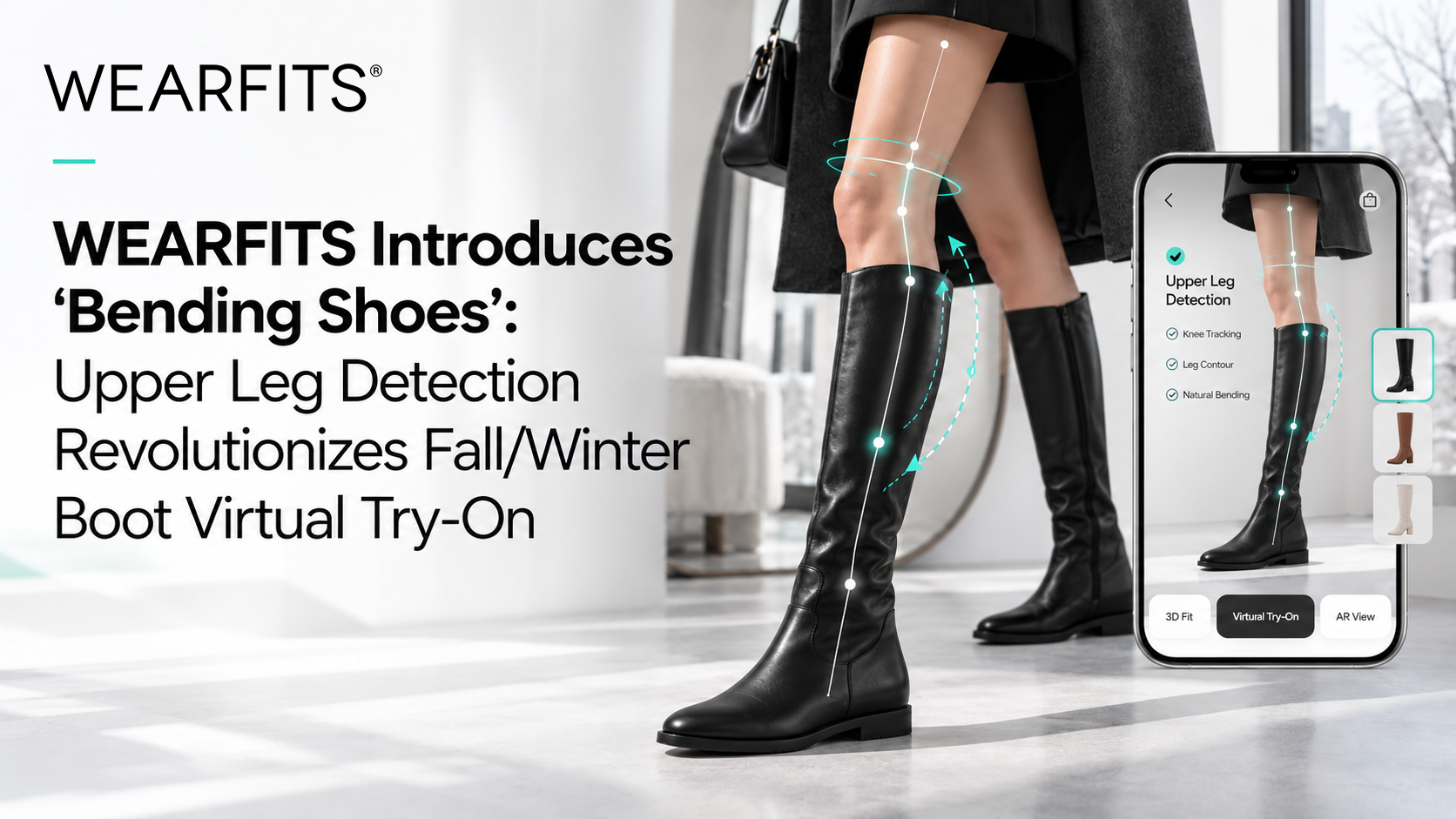
In October 2026, we introduced our WEARFITS Bending Shoes technology, which combines upper-leg detection with dynamic boot movement to create more natural AR experiences for tall footwear.
This functionality is especially valuable for knee-high boots and similar products, where tracking the foot alone cannot accurately represent the entire item.
Our Bending Shoes technology works also with Gaussian Splats.
6. Photo-to-3D vs. Gaussian Splatting: key differences
| Feature | AI Photo-to-3D Mesh | 3D Gaussian Splatting |
|---|---|---|
| Asset structure | Polygonal geometry with textures | Gaussian primitives |
| Photography | Can use a few product images | Typically benefits from many overlapping views |
| Visual quality | Detailed geometry and PBR materials | Strong photorealistic appearance |
| File optimization | Established mesh and texture compression | Specialized splat compression |
| Mobile AR | Mature rendering ecosystem | More implementation-dependent |
| E-commerce scaling | Well suited to automated product pipelines | May require more capture and processing work |
The best choice ultimately depends on whether the primary goal is photographic presentation or dynamic real-time interaction.
7. Which technology should footwear brands choose?
Neither Photo-to-3D meshes nor Gaussian Splatting should be considered universally superior.
Each provides advantages for different digital commerce applications.
When gaussian splatting makes sense
Gaussian Splatting may be the right option when a brand wants to create photorealistic product showcases, experimental 3D presentations, or premium visual content.
It is particularly interesting for experiences where surface appearance and viewpoint-dependent detail matter more than complex deformation.
Brands with controlled photography environments and dedicated 3D production resources may find this technology valuable for specific campaigns.
When Photo-to-3D meshes are the better fit
AI-generated mesh assets are generally more practical when the objective is to launch scalable footwear virtual try-on across an online catalog.
They are especially relevant for businesses that want to:
- Convert existing footwear photos into interactive 3D models.
- Reduce manual 3D modeling requirements.
- Deliver lightweight, browser-based AR experiences.
- Prepare new collections efficiently as product assortments grow.
For these applications, the combination of automated asset generation, standard 3D formats, and animation compatibility offers significant practical value.
8. How WEARFITS makes footwear Virtual Try-On more accessible
At WEARFITS, we believe that advanced AR shopping technology should not require brands to rebuild their entire content production process.
Our AI-powered Photo-to-3D solution helps transform conventional footwear photographs into interactive three-dimensional assets.
By connecting automated 3D reconstruction with browser-based AR experiences, we help businesses move beyond static product imagery.
Retailers can create opportunities for shoppers to examine digital footwear on their own feet, explore designs more interactively, and better understand how a product may look before purchasing.
Our approach also supports integration into existing online shopping environments, helping brands introduce virtual try-on without requiring customers to install a separate application.
Combined with innovations such as dynamic shoe bending, this creates a foundation for increasingly realistic digital footwear experiences.
Final Thoughts: Choosing the right 3D strategy for e-commerce
Photo-to-3D and Gaussian Splatting are both contributing to the evolution of 3D commerce, but they solve different technical challenges.
Gaussian Splatting stands out for its ability to recreate detailed visual appearances from captured imagery. Similar to traditional 3D models, Gaussian Splats can also be animated and dynamically deformed, enabling realistic movement and interaction in real-time AR experiences.
For footwear retailers, these operational differences are crucial.
A successful virtual try-on experience must look convincing, load efficiently, respond naturally to movement, and work within real-world mobile shopping conditions.
For most brands implementing interactive footwear AR at scale, AI-powered Photo-to-3D mesh workflows currently offer the more practical balance of visual quality, flexibility, and deployment efficiency.
At WEARFITS, our goal is to make that technology accessible, helping footwear businesses transform existing product images into engaging digital shopping experiences.
Ready to bring interactive 3D footwear to your online store? Explore WEARFITS Photo-to-3D and AR Virtual Try-On and discover how AI-powered product digitization can support your next generation of e-commerce experiences.
Related posts
WEARFITS Launches Bending Shoes Technology: A New Era of AR Virtual Try-On for Tall Boots

The Integration Era: 5 Lessons from Stride 2026 That Are Redefining Footwear

One foot scan, every shopping channel: how Reusable Footwear Fit Profiles transform omnichannel retail
