One foot scan, every shopping channel: how Reusable Footwear Fit Profiles transform omnichannel retail

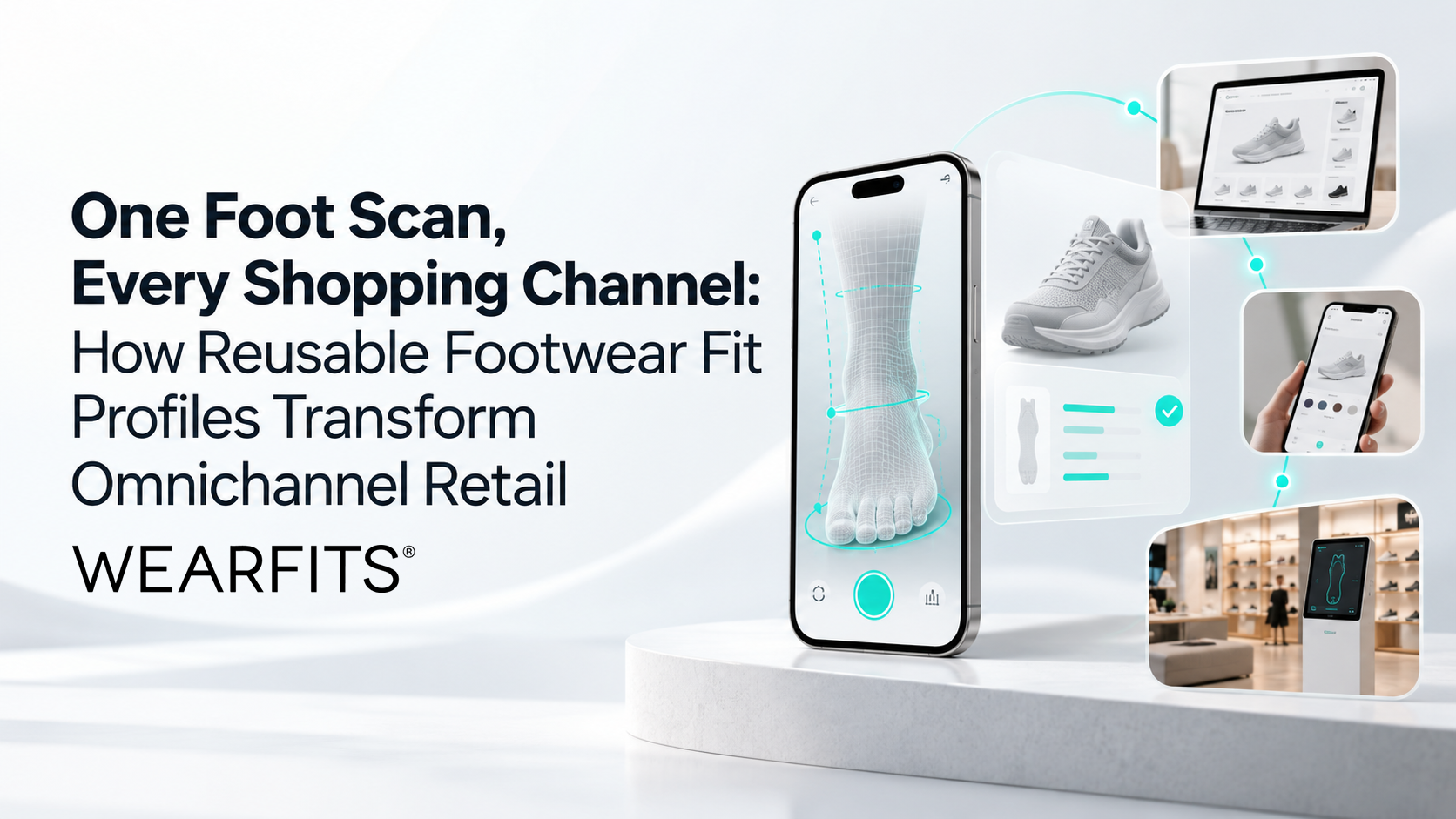
Why the future of shoe shopping starts with one measurement
Buying shoes should be simple. Yet for many online shoppers, finding the right size remains one of the biggest obstacles to completing a purchase. Size charts are often inconsistent, different footwear brands use different measurements, and even shoes from the same manufacturer can fit differently.
This uncertainty has a direct impact on retailers. Customers may abandon their carts, order several sizes of the same product, or return footwear that does not fit as expected. These challenges increase operational expenses and make it harder to build lasting customer relationships.
As we explain in our WEARFITS guide to virtual shoe sizing and AI fit prediction, combining accurate foot measurements with augmented reality helps address two important shopping questions: how a shoe will look and whether it is likely to fit.
At WEARFITS, we believe the next step is making those measurements reusable.
Instead of treating footwear sizing as a separate process during every purchase, retailers can build a reusable footwear fit profile that connects customer measurements with different products and shopping channels.
The idea is straightforward: measure both feet, save your measurements, and reuse that information when shopping through connected channels. Update the profile whenever foot dimensions or fitting needs change.
This approach creates the foundation for more personalized, convenient, and connected footwear shopping.
What is a Reusable Footwear Fit Profile?
A reusable footwear fit profile is a digital record of a customer's foot measurements that can support personalized shoe size recommendations across multiple shopping sessions.
Unlike traditional sizing systems that ask shoppers to select their usual EU, UK, or US size, a measurement-based profile focuses on the actual dimensions of their feet.
A customer might normally wear EU 42, but that number alone cannot describe the shape of their feet or guarantee a comfortable fit in every shoe.
A reusable profile provides more meaningful information.
For footwear retailers, the goal is to connect this measurement data with product-specific sizing information so recommendations can be generated without requiring a new scan for every purchase.
When linked to a customer account, the same profile can potentially support purchases through an e-commerce website, mobile experience, or connected physical store.
The essential advantage is measurement continuity: customers do not need to start their sizing journey from zero every time they discover a new product.
1. From Basic Shoe Sizes to a Detailed Foot Measurement Profile
Conventional shoe sizing generally focuses on foot length, sometimes supported by width measurements. However, two people with identical foot lengths may experience completely different levels of comfort in the same shoe.
That is because a proper fit depends on several aspects of foot geometry.
The current WEARFITS Size & Fit guide describes the following measurement outputs:
- Foot length: Left and right foot lengths are recorded separately, providing the basic reference for shoe sizing.
- Ball width: The width across the forefoot, which affects how comfortably the foot fits inside the shoe.
- Ball girth: The circumference around the widest part of the forefoot, helping assess available interior volume.
- Instep girth (estimated): The circumference around the upper midfoot, helping describe the space needed across the instep.
- Heel girth (estimated): A measurement around the heel region that adds information about foot shape and potential heel fit.
Together, these measurements create a more detailed picture than a standard shoe size.
Our AI foot measurement and brand-specific sizing technology uses smartphone-based computer vision to capture foot dimensions without a dedicated in-store scanner.
According to the current WEARFITS Size & Fit scanning guide, customers scan through the WEARFITS app or an integrated retailer app, without a reference card or paper marker. Camera capture typically takes 30–90 seconds, with about a further minute for processing. WEARFITS reports approximately ±2 mm accuracy relative to a professional podiatrist scan under suitable conditions; this is a measurement claim, not a guarantee of comfort in a particular shoe.
This makes detailed foot measurement more accessible to online shoppers while reducing the need for manual measuring tools or visits to specialist stores.
2. How a Saved Foot Profile Connects Online and Offline Shopping
An accurate measurement becomes significantly more valuable when customers can use it beyond the session in which it was created.
Imagine a shopper who measures their feet through an integrated footwear retailer app. They receive a recommended size, explore several styles, and leave without making a purchase.
A few days later, they return to the retailer’s website. If the app and website share an account-linked profile, the saved measurements can support recommendations without another scan.
This is the principle behind a persistent footwear fit identity.
Guest Shopping and Account Synchronization
A convenient customer experience should not require shoppers to register before exploring their options.
A reusable sizing architecture can initially associate measurements with a temporary browsing session. When a customer creates an account or signs in, the profile can be linked to their account identity, subject to appropriate consent and privacy controls.
This connection creates opportunities to combine measurement-based recommendations with purchase history, saved products, and customer preferences.
For returning shoppers, the main benefit is convenience: fewer repeated steps and faster access to relevant size guidance.
Connecting Physical Stores With Digital Experiences
Reusable measurement profiles can also support omnichannel retail strategies.
For example, a footwear retailer could connect an in-store AR mirror experience with a customer's mobile shopping journey.
A QR-based handoff could allow the shopper to continue exploring a product at home, while an account-linked sizing profile could preserve the relevant measurement information.
These connected experiences require suitable identity management and system integrations. However, they demonstrate how physical retail and online commerce can share the same customer-sizing foundation.
As our WEARFITS footwear virtual try-on solution shows, augmented reality can already extend across product pages and in-store digital mirror experiences.
3. Why One Foot Profile Should Not Mean One Universal Shoe Size
Saving foot measurements does not mean assigning customers a permanent size that applies to every footwear brand.
In fact, doing so would reproduce one of the main weaknesses of traditional size charts.
Every footwear model is designed around a particular shoe last: the three-dimensional form used to determine its shape, dimensions, and internal proportions.
Two shoes marked EU 42 may therefore provide very different fitting experiences.
Several factors influence these differences.
Shoe construction and shape. Running shoes may provide additional room around the toes, while formal footwear often uses narrower or more tapered silhouettes.
Material flexibility. A knitted upper can adapt differently to foot volume than structured leather or other relatively rigid materials.
Fastening systems. Laces and adjustable straps allow customers to modify how tightly footwear fits, while slip-on designs generally provide less adjustment.
Brand-specific sizing standards. Manufacturers use different lasts and size specifications, meaning numerical conversions alone cannot reliably predict comfort.
This is why intelligent sizing must connect two separate types of information: the customer's foot geometry and the dimensions of the particular shoe being considered.
We explore these differences further in our article on why people wear the wrong shoe size and how AI can improve footwear fitting.
A reusable profile provides consistent customer measurements, while the recommendation changes according to the selected shoe.
That distinction is fundamental to effective AI shoe sizing.
4. How WEARFITS Combines AI Size Recommendations With AR Virtual Try-On
At WEARFITS, we approach virtual footwear fitting as more than a visualization feature.
Seeing a digital sneaker on your feet can help you decide whether you like its appearance. However, a realistic visual representation cannot independently confirm whether the physical shoe will feel comfortable.
Customers need both visual confidence and fit guidance.
Our technology brings these capabilities together through three connected processes.
AI-Powered Foot Scanning
First, computer vision analyzes the customer's feet to generate measurement information.
The smartphone-based scanning workflow removes the need for a dedicated in-store scanner. Reusing its results on a retailer’s website requires an appropriate integration; browser-based AR visualization is a separate capability.
Product-Specific Size Matching
Next, the measured foot data is compared with the footwear brand's sizing information.
Instead of relying exclusively on generic international size conversions, the system can account for relevant specifications associated with individual styles and sizes.
This enables more personalized recommendations.
For example, a customer might receive a recommendation for EU 42 in one sneaker and EU 43 in another, depending on the available product data and fit requirements.
Augmented Reality Fit Visualization
Finally, AR virtual try-on allows the shopper to see a digital version of the selected footwear on their own feet.
Where the appropriate sizing integration and product information are available, a visual fit heatmap can also indicate areas of predicted tightness or comfortable clearance.
These indicators are estimates derived from measurements and product geometry, rather than physical pressure readings.
By combining AR visualization with AI fit prediction, we help retailers answer both questions that matter most before checkout: Does this shoe look right, and is this size likely to fit?
5. Customer Privacy and Control Over Foot Measurement Data
Reusable fit profiles can improve the shopping experience, but they also require responsible handling of personal measurement information.
Customers should understand what information is collected, how it is used, and whether it will remain available for future purchases.
Privacy should therefore be considered from the beginning of the system design.
A reusable profile needs a clear data-handling design. Retailers should document where camera data is processed, which measurements are saved, how long they are retained, and which systems can access them. Smartphone scanning alone does not establish that every processing step stays on the device.
For persistent customer profiles, retailers should also implement clear consent mechanisms, appropriate security measures, and accessible profile-management options.
A well-designed system should allow customers to update measurements when necessary, understand their data-sharing choices, and request deletion of stored information.
Retailers operating in the EU should review their implementation against applicable data-protection requirements, including the GDPR, with appropriate specialist advice.
Ultimately, the value of a reusable fit profile depends not only on measurement accuracy but also on customer trust.
6. Building the Next Generation of Omnichannel Footwear Experiences
Reusable measurement technology creates opportunities that go beyond recommending a size on an individual product page.
The WEARFITS footwear ecosystem already includes capabilities such as browser-based AR shoe visualization, AI-supported sizing workflows, product-specific fit guidance, and integration options for e-commerce platforms.
Our WEARFITS shoe try-on platform supports online retail experiences and in-store digital mirror applications, while advanced sizing functionality can be implemented through the appropriate API integration.
Looking ahead, several developments could make reusable fit profiles even more powerful.
Universal fit profiles across brands. A customer-controlled measurement identity could support personalized recommendations across participating footwear retailers.
Family measurement accounts. Households could manage separate fit profiles for different family members through one account.
Automatic size filtering. Product listings could prioritize available shoes and sizes likely to match a customer's saved measurements.
Changing fit requirements. Future systems could support updated profiles reflecting orthotics, changes in foot dimensions, or different fitting preferences.
Deeper retail system connections. Integrations with customer databases, loyalty platforms, and point-of-sale systems could make sizing information more accessible across shopping channels.
These are potential extensions of the reusable profile concept, not features that should be assumed to be available in every current implementation.
The long-term objective is to make individual foot measurements useful wherever customers interact with footwear products.
7. Business Benefits of Reusable Footwear Fit Profiles
For footwear brands, a reusable fit profile is more than a customer convenience feature. It can become an important component of a wider e-commerce optimization strategy.
Fewer Size-Related Returns
When customers understand which size is most likely to fit, they can make better-informed purchasing decisions.
In our analysis of AR shoe try-on and AI fit prediction, we discuss the potential for combined visualization and measurement technology to reduce return-related costs.
Actual improvements will depend on factors including product assortment, customer behavior, implementation quality, and the retailer's existing return rate.
Less Size Bracketing
Some shoppers purchase the same shoe in multiple sizes because they are unsure which one to choose.
Providing personalized sizing recommendations can reduce the uncertainty that encourages this behavior, potentially lowering unnecessary shipments and reverse-logistics costs.
Faster Repeat Purchases
Returning customers should not need to complete the same measurement process for every order.
A securely saved profile can shorten the path from product discovery to selecting a size and adding an item to the cart.
Greater Customer Confidence and Loyalty
A personalized shopping experience can make customers feel better supported when choosing footwear.
Consistent fit guidance may strengthen confidence in a retailer and encourage future purchases, particularly when customers have previously experienced sizing difficulties.
More Valuable Omnichannel Experiences
When sizing information is available across connected customer touchpoints, online stores and physical retail locations can deliver a more consistent experience.
This creates opportunities for personalized recommendations without forcing customers to repeat earlier steps.
8. How Retailers Can Measure the Impact
To understand the commercial value of reusable footwear fit profiles, retailers should monitor performance before and after implementation.
Important indicators include:
- Size-related return rate: The proportion of purchases returned because of sizing or fit problems.
- Conversion rate: Whether shoppers using AI sizing and AR try-on complete more purchases.
- Repeat purchase rate: How frequently customers with saved profiles return to buy additional footwear.
- Time to add to cart: Whether existing measurements help returning shoppers select sizes more quickly.
- Multiple-size ordering: Whether customers become less likely to order several sizes of the same model.
- Customer lifetime value: Whether more confident shopping experiences contribute to stronger long-term relationships.
Where practical, retailers should use a randomized A/B test and compare equivalent customer groups, accounting for differences in products, traffic, and seasonality. Comparing only people who choose to scan with people who do not can introduce selection bias. Return-rate comparisons also need enough time for the return window to close.
This makes it easier to distinguish the actual effects of personalized sizing from other factors influencing e-commerce performance.
The Future of Footwear Shopping Is Connected, Personalized, and Measurement-Driven
Traditional shoe sizing asks customers to interpret size charts and hope that the selected number will work.
A reusable footwear fit profile offers a different approach.
By capturing meaningful foot measurements and connecting them with product-specific information, retailers can move toward personalized recommendations that remain useful across multiple shopping sessions.
At WEARFITS, our vision is to make virtual footwear shopping more intuitive by bringing together AI foot measurement, intelligent size matching, and realistic augmented reality experiences.
Rather than separating visual try-on from fit prediction, we believe both should work together as part of a connected customer journey.
As omnichannel retail continues to develop, reusable measurement profiles can become an important foundation for reducing shopping friction, supporting customer confidence, and creating more efficient footwear commerce.
One measurement. More personalized recommendations. A connected shopping experience.
Ready to bring intelligent footwear sizing and virtual try-on to your store? Explore WEARFITS and discover how our solutions can support your footwear e-commerce strategy.
Related posts
How to Measure Your Feet with WEARFITS Size & Fit Solution: The Ultimate Guide (+ VIDEO)
Why Over 60% of People Wear the Wrong Shoe Size—and How AI Is Changing Footwear Fitting
Custom Shoe Sizing at Scale: From Smartphone Foot Scanning to Bespoke Footwear Production
