Virtual Try-On Shoes: How AR Fixes Online Sizing Anxiety


Virtual try-on for shoes is the only PDP tool that solves online sizing anxiety — the specific psychological barrier that stops shoppers from clicking "buy" on a pair of shoes they can't physically test. This article explains the psychology behind the problem, why traditional size charts structurally cannot fix it, how AR-based virtual try-on does, and what the published data shows on conversion lift and return reduction. WEARFITS is an AI-powered virtual try-on platform for footwear, bags, and apparel — and the patterns below come from running custom rollouts of this technology with luxury houses, mass-market retailers, and now Shopify merchants.
WHY ONLINE SHOE SHOPPING IS PSYCHOLOGICALLY HARDER THAN SHOPPING FOR ANYTHING ELSE
The footwear industry has spent fifteen years trying to fix online shoe sizing with better size charts, longer descriptions, and clearer photography. None of it worked. Footwear is still the second-highest e-commerce return category, with 18% of shoes purchased online sent back — driven almost entirely by sizing uncertainty.
The reason this problem has been so stubborn is psychological, not technical. Shoppers don't return shoes because the size chart was wrong. They return shoes because they bought multiple sizes on purpose, to insure against the chart being wrong. The behavior is rational; the technology that creates it is what needs to change.
THE PSYCHOLOGY OF FIT ANXIETY
Shoppers experience a specific form of stress when they browse for shoes online. We call it "fit anxiety" — the fear that the shoe won't fit, combined with the foreseen hassle of returning it. It's a different category of friction from the regular uncertainty of online shopping. When a shopper looks at a pair of sneakers on a screen, they don't see just a product. They see a potential problem: the return label, the repackaging, the trip to the post office, the wait for the refund.
This anxiety produces decision paralysis. Shoppers abandon carts not because they don't want the shoes — they abandon them because the risk of a bad fit outweighs the excitement of the new purchase. The classic abandonment-recovery email flow doesn't help here, because the friction isn't price or shipping — it's the fundamental absence of physical confirmation.
Visual confirmation plays a particularly important role in how humans make decisions. Research published in Frontiers in Behavioral Neuroscience finds that around 65% of the population are visual learners — they process information more reliably when they can see it rather than read about it. When a description says a shoe "runs true to size," shoppers still feel uncertain. When they see the shoe on their own foot through a virtual try-on, their brain processes that visual as a confirmation. This is the same psychological mechanism behind the endowment effect: people value a product more when they can imagine themselves owning it.
Virtual try-on for shoes connects the static product image to the experience of ownership. It's the closest digital analogue to picking up a pair of shoes in a store, putting them on, and looking down. The reduction in friction is enormous, and it shows up directly in the conversion numbers.
WHY TRADITIONAL SIZING METHODS FAIL — STRUCTURALLY
The standard online shoe sizing tools — size charts, brand-by-brand conversion tables, "true to size" descriptions — all fail for the same root reason. They are two-dimensional approximations of a three-dimensional problem.
A foot has length, width, arch height, toe-box volume, heel shape, and instep depth. A shoe accommodates all six of those. A size chart that reduces this to a single number — "you wear an 8.5" — is throwing away most of the information that actually determines fit. Two shoes labelled "size 8" can fit completely differently on the same foot if one is built on a wider last or a higher arch.
The problem gets worse over time. The Wall Street Journal reports that average shoe sizes in the U.S. have grown by nearly a full inch since the 1970s, driven by changes in lifestyle, diet, and average body composition. But the manufacturing molds — the "lasts" that shoes are built around — have largely stayed the same. Around 99% of shoes sold in the U.S. are imported, and the molds reflect foot shapes from decades ago. Even if a customer knows their exact size, the shoe itself may be built on a mold that doesn't resemble their foot.
Shoppers have noticed. Zalando's research on shopper confidence found that more than 40% of online shoppers cite poor-quality size guides as a major reason they don't buy. The size chart isn't just inadequate — it's actively undermining trust. The shopper has no reason to proceed when the only tool they have to predict fit is the tool they've learned to distrust.
HOW DIGITAL FOOTWEAR FITTING WORKS
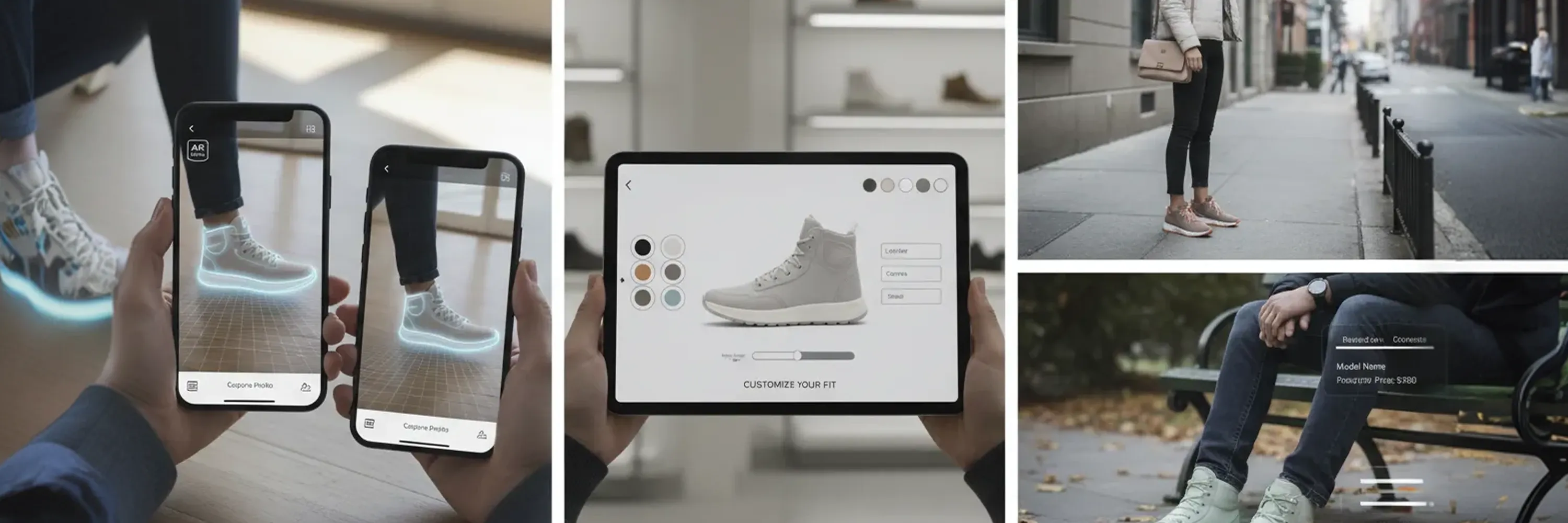
Modern virtual try-on for shoes uses Augmented Reality and 3D foot tracking to simulate a physical try-on through a smartphone. The shopper points their camera at their feet, and the software renders a 3D model of the chosen shoe on top of the camera image in real time. They can move their feet, turn at angles, and watch the materials follow naturally. The result is a near-physical preview of how the shoe will look in motion.
The underlying technology has evolved significantly in the past few years. Earlier versions used simple 2D image overlays that gave a flat, sticker-like preview. Modern systems use proper depth tracking and 3D foot models. SafeSize's research on 3D foot scanning shows that personalized scans and 3D-aware recommendations can drive significantly higher conversion than 2D-only experiences. The shopper moves from a state of uncertainty to a state of visual confirmation.
The accessibility constraint matters as much as the technical capability. Most modern implementations work directly in a mobile browser — no app download, no special equipment, no technical skills. The shopper holds their phone, the AR view opens inside the product page, and they're trying on the shoe within seconds. WEARFITS, a web-first virtual try-on solution founded in Krakow, was built specifically around this constraint: footwear AR has to work without forcing shoppers to download an app, because the app friction kills 80%+ of potential engagement.
WHAT THE CONVERSION AND RETURN DATA ACTUALLY SHOWS
The headline numbers are striking. Shopify's published data on AR in commerce indicates that products featuring 3D and AR content can see conversion rate increases of up to 94% versus 2D-only equivalents, and return rates fall by up to 40%. These are best-case numbers — the real-world lift depends heavily on PDP placement, button discoverability, and whether the AR view is the default state (we've written extensively on how to get this right in our Shopify virtual try-on implementation guide).
The case study evidence reinforces the pattern. Shopify's case study on Gunner Kennels — a brand whose returns were driven primarily by customers being unsure whether a kennel would fit their dog — showed AR visualization cut their return rate by 5% and eliminated significant shipping costs along with it. The shoe-shopping problem is structurally identical: a shopper unsure whether a product will fit their body.
For footwear specifically, the WEARFITS pilots have consistently shown around 20% reduction in size-related returns on SKUs with AR try-on enabled, versus matched-control SKUs without it. The size-related share of returns is the share that AR moves — other return reasons (style mismatch, fulfillment errors) are unaffected. But sizing is roughly 60–80% of total returns in footwear, so a 20% cut on the size slice translates to a 12–16% cut on total returns.
THE ENVIRONMENTAL CASE FOR VIRTUAL TRY-ON
The bracketing behavior that virtual try-on eliminates carries a real environmental cost. Every returned pair of shoes involves two-way shipping emissions, packaging waste, and — if the product can't be resold — landfill disposal. Footwear is particularly prone to write-down on returns because the material wear from in-home try-on rarely survives a quality check for A-stock resale.
The math is direct. A shopper who orders three sizes and returns two has tripled their shipping footprint versus the shopper who ordered one. Across the global e-commerce footwear category, this adds up to a significant share of fashion's overall return-driven emissions.
For environmentally conscious shoppers, this creates a "moral cost" attached to the convenience of online shopping. Many of them ration their online shoe purchases or default to physical stores specifically to avoid the return cycle. Virtual try-on removes that moral cost because it eliminates the reason for bracketing. The shopper gets the visual confirmation they need, picks the right size on the first try, and the second and third pair never get shipped.
This is sustainability that aligns with the shopper's own incentive, not just the brand's. Which is why the adoption curve has been so steep wherever AR try-on has been deployed correctly.
REDUCING POST-PURCHASE ANXIETY
Fit anxiety doesn't end at checkout. It continues through the entire period between order and delivery. Shoppers second-guess their decision, check their email obsessively for shipping updates, and pre-read the return policy in case the shoes don't fit.
This isn't a niche behavior. Narvar's 2025 State of Post-Purchase Report found that two-thirds of consumers feel anxiety after clicking "buy," and 90% check the return policy before they buy to make sure they have an escape route. The post-purchase anxiety period is now defining the e-commerce experience as much as the pre-purchase decision is.
Virtual try-on collapses this anxiety window. When a shopper has already seen the shoe on their foot before buying, the arrival of the package is a confirmation, not a moment of suspense. The "did I get this right?" stress that runs from checkout to delivery is largely gone. This shows up as fewer support tickets, fewer cancellations during shipping, and meaningfully higher customer satisfaction scores in post-purchase surveys.
The longer-term effect is loyalty. A shopper who has had a stress-free experience with a brand's virtual try-on returns to that brand specifically because the emotional labor of shopping is lower. Brands with AR try-on become the default for shoppers who have learned to associate them with low-anxiety buying.
THE FUTURE OF ONLINE FOOTWEAR SHOPPING
Virtual try-on is on a trajectory to become a baseline expectation for online footwear, not a differentiator. The data on personalization makes this clear. McKinsey's research on the next frontier of personalized marketing found that 71% of consumers expect personalized interactions, and 76% are frustrated when they don't get them. Virtual try-on is the most direct form of personalization — it places your product on your customer's actual body, in their actual environment.
The competitive ground will shift over the next 24 months. Brands that offer immersive AR try-on will set the expectation for the category, and brands that don't will look outdated and risky by comparison. We've already seen this curve play out with brand-specific examples: Nike rolled out Nike Fit specifically to address sizing uncertainty and reduce returns, and the pattern of large footwear retailers investing in similar tools has accelerated since.
For most footwear brands selling on Shopify, the entry point is straightforward. WEARFITS deploys across Shopify, mobile WebViews, and in-store mirrors from one integration — the Shopify plugin gets the Try-On button onto your PDP and your shoes digitized into 3D models, without CAD files. The custom layer (sizing, fit prediction, in-store mirrors) sits on top via the WEARFITS API for brands that need more.
WHERE TO START IF YOU'RE A SHOPIFY MERCHANT
If you sell shoes on Shopify and you're sitting at a 25–30% return rate, the prioritisation is straightforward. The Shopify plugin handles the Try-On button placement and the photo-to-3D catalogue indexing — usually live in about 90 minutes once the catalogue is indexed. Then the PDP placement work, the PLP badging, the launch announcement, and the analytics wiring follow on a 60-day schedule. We've documented the full Shopify rollout in our Shopify implementation guide, and the discoverability/UX side in our Try-On UX placement playbook.
The economic case is favourable. If your footwear store does €10M GMV at a 25% return rate, the all-in cost of processing returns is somewhere between €600K and €900K annually. A 20% cut on the size-related share (60–80% of total returns) saves €70–145K a year on its own — before you count the conversion lift on enabled SKUs. The catalogue indexing cost is recovered inside Q1 for most stores.
THE SHORTEST VERSION
Online shoe shopping is psychologically harder than online shopping for any other category because shoes are the only product where fit is both unmeasurable from a chart and unrecoverable from a return. Virtual try-on for shoes solves this by placing the product on the shopper's actual foot through their smartphone camera — providing the visual confirmation that size charts structurally can't. The published data shows up to 94% conversion lift and up to 40% return reduction on AR-enabled products, with bracketing falling sharply as a side effect. WEARFITS deploys across Shopify, mobile WebViews, and in-store mirrors from one integration, with the Shopify plugin covering Try-On + shoes digitization out of the box.
If you run a footwear store on Shopify and want to see WEARFITS on your own SKUs:
- Install the WEARFITS Shopify app — first 50 SKUs free during the trial.
- Talk to us about sizing and custom implementations — for the AI fit prediction layer and in-store mirrors.
Frequently asked questions
Quick answers to the questions teams ask most about this topic.
Virtual try-on for shoes is an AR-based feature that lets an online shopper see a pair of shoes rendered on their own feet through their smartphone camera, before buying. The shopper points the camera at their feet, the software places a 3D model of the shoe in the image, and they can rotate, view angles, and see how the materials move. It works in any modern mobile browser — no app download required.
Standard size charts measure foot length only — they don't account for arch height, toe width, or heel shape. Worse, manufacturing standards vary between brands (a size 8 in one brand can fit like a 7 in another), and most shoes are built on outdated 'lasts' (molds) that don't reflect modern foot anatomy. According to the Wall Street Journal, average shoe sizes in the U.S. have grown by nearly an inch since the 1970s, but the molds haven't kept up. Static size charts are structurally obsolete.
Yes — significantly, when it's paired with size guidance. Shopify's published data shows that products with 3D and AR experiences see conversion rates up to 94% higher and return rates fall by up to 40%. In the Shopify Gunner Kennels case study, AR visualization cut return rate by 5% on a category where size and scale are the primary return drivers. For footwear specifically, the WEARFITS pilots have shown around 20% reduction in size-related returns when AR try-on is paired with AI fit prediction.
Bracketing is when a shopper orders the same shoe in multiple sizes — say a 9, 9.5, and 10 — with the intention of returning the two that don't fit. It's a workaround for the lack of confidence in size charts. Statista data ranks footwear as the second-highest e-commerce return rate at 18%, largely because of bracketing. Virtual try-on reduces bracketing because the shopper can pick the right size on the first try.
No. Modern virtual try-on for shoes runs in any mobile browser — no app download, no special hardware. WEARFITS specifically uses a web-first architecture so shoppers can try on shoes directly from a Shopify product page or any other e-commerce site, on any iOS or Android device with a camera.
Every avoided return is avoided shipping emissions, packaging waste, and landfill risk. Bracketing alone — where shoppers order multiple sizes to return the wrong ones — accounts for a meaningful share of fashion's return-driven carbon footprint. By reducing bracketing and first-time fit errors, virtual try-on directly cuts the environmental cost of online shoe shopping. For environmentally conscious shoppers, it removes the 'moral cost' of the convenience of buying online.