Why One Shoe Size Fits Differently: Sneakers, Court Shoes, and High Heels

Introduction: Same Size, Different Experience
A customer orders three pairs of shoes, all in EU size 38: everyday sneakers, classic leather court shoes, and elegant 90 mm stilettos. On paper, the sizing is identical. In reality, the experience can be completely different.
Consider a typical footwear retailer reviewing its latest returns:
- Everyday knit sneakers: 8% return rate
- Classic leather court shoes: 22% return rate
- 90 mm stiletto heels: 34% return rate
Customer feedback reveals what the numbers cannot. Sneakers feel comfortable, court shoes create pressure around the instep, and high heels cause toes to slide forward while the heel slips out.
The problem isn't necessarily incorrect sizing. It's that the same size behaves differently depending on shoe construction, materials, and foot anatomy.
At WEARFITS, we believe footwear fit should be understood as a three-dimensional relationship between the foot and the shoe, rather than a simple number on a size chart.
For e-commerce managers and footwear brands, understanding these differences is essential. Better fit recommendations mean fewer returns, more confident shoppers, and healthier profit margins.
1. Understanding Fit Tolerance Across Footwear Categories
Our feet aren't completely static. Their volume can fluctuate by up to 5% throughout the day due to movement, temperature, and natural swelling.
Some shoes adapt easily to these changes. Others leave very little room for variation.
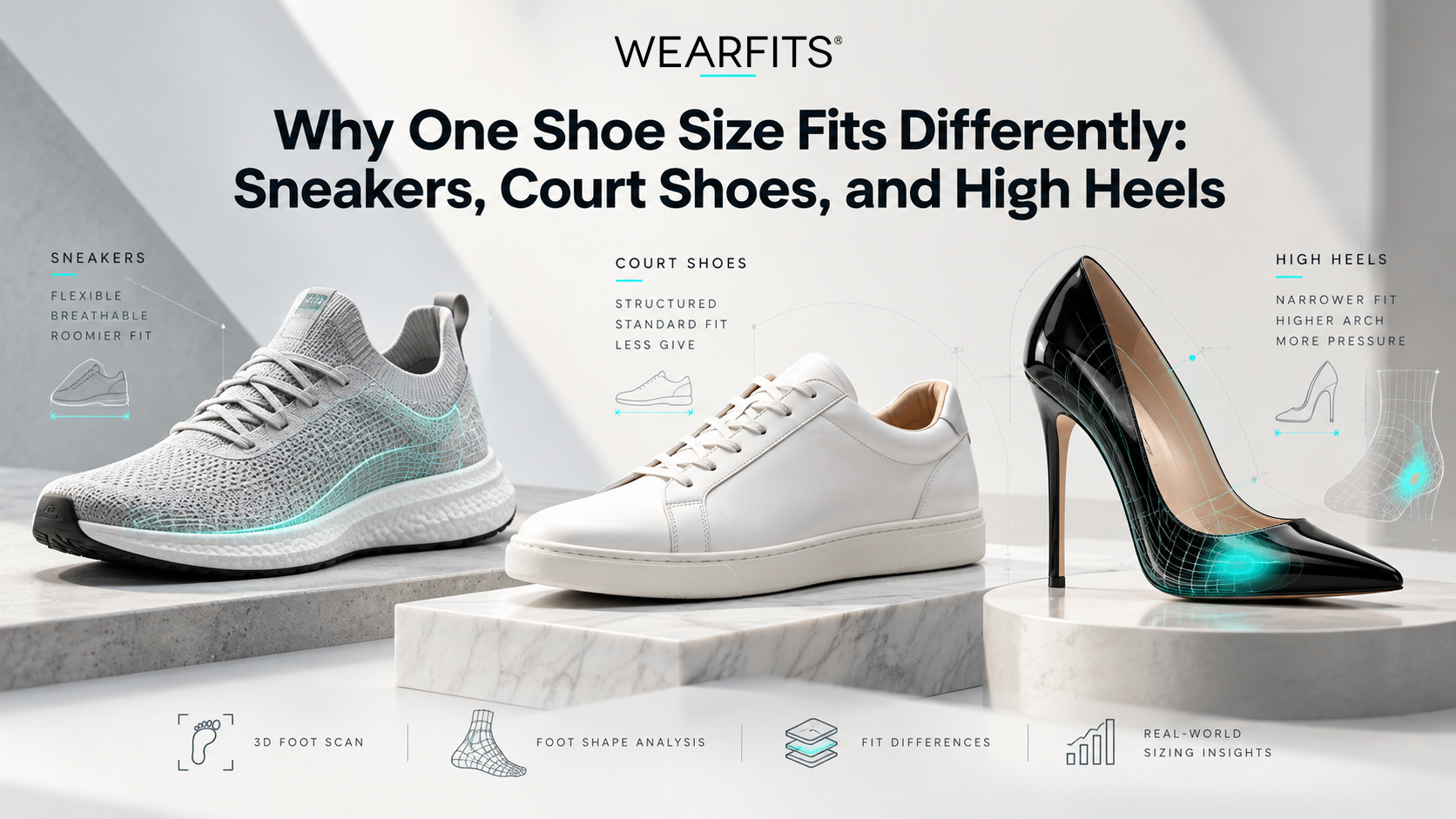
This creates a spectrum of fit tolerance, ranging from flexible sneakers to structured footwear where even a small mismatch can affect comfort.
Sneakers: Designed to Adapt
Lifestyle and performance sneakers generally offer the greatest flexibility.
Features such as engineered mesh, knitted uppers, soft padding, and adjustable laces allow them to accommodate natural differences in foot shape. Depending on construction, sneakers may comfortably absorb approximately 3–5 mm of variation in ball girth or instep height.
When the foot expands, the upper can stretch. If additional space is needed, the laces provide an easy adjustment.
This flexibility explains why sneakers are relatively forgiving when it comes to minor width differences. Significant internal length mismatches, however, can still cause problems.
For retailers, this means sneaker fit recommendations can often allow a slightly wider tolerance than those used for structured footwear.
Court Shoes: Precision Matters More
Traditional court shoes, leather oxfords, and structured loafers behave very differently.
Rigid soles, firm heel counters, and less flexible leather uppers limit how much the shoe can adapt to the wearer.
Unlike sneakers, many of these styles don't offer adjustable closures. The opening is fixed, and a foot with a higher instep or wider forefoot may experience uncomfortable pressure.
The opposite issue is equally important. A heel area that's only 1.5 mm too wide can contribute to slipping, especially when the sole doesn't flex naturally with the foot.
This is why looking at foot length alone tells only part of the story. A successful fit must also consider instep height, ball girth, and heel geometry.
High Heels: Small Differences, Big Consequences
High heels introduce another challenge: the angle of the foot.
With elevated heel pitch, as much as 70–80% of body weight may be concentrated around the metatarsal heads, or the ball of the foot.
Gravity also encourages the foot to move forward inside the shoe. Consequently, the shape of the toe box, heel cup, and shank all become critical.
Even a 1 mm mismatch can have a noticeable effect.
Too much internal length allows the foot to slide forward, increasing toe pressure and creating gaps around the heel. Too little room across the forefoot may make the shoe uncomfortable almost immediately.
For this category, fit prediction needs to account for weight distribution, forward movement, and the geometry of the elevated foot.
Sandals: A Different Kind of Fit Challenge
Open-toe sandals and strappy styles have their own requirements.
Without an enclosed toe box or traditional heel counter, the foot relies on strategically positioned straps for stability.
These straps must align with the wearer's forefoot, instep, and ankle geometry. Otherwise, the foot may extend beyond the sole or experience uncomfortable pressure.
Sandals also create challenges for virtual try-on. Augmented reality needs accurate masking and positioning to make straps appear naturally around the foot rather than floating above it or cutting through the skin.
2. Why Traditional Shoe Size Charts Aren't Enough
For years, online footwear stores have relied on size conversion tables.
A shopper sees that US 8 corresponds to EU 39 or UK 6 and assumes the fit will be comparable.
Unfortunately, real-world footwear sizing is much more complicated.
Generic conversion charts have been associated with only 42% accuracy, highlighting the limitations of treating shoe size as a universal standard.
Three factors explain why.
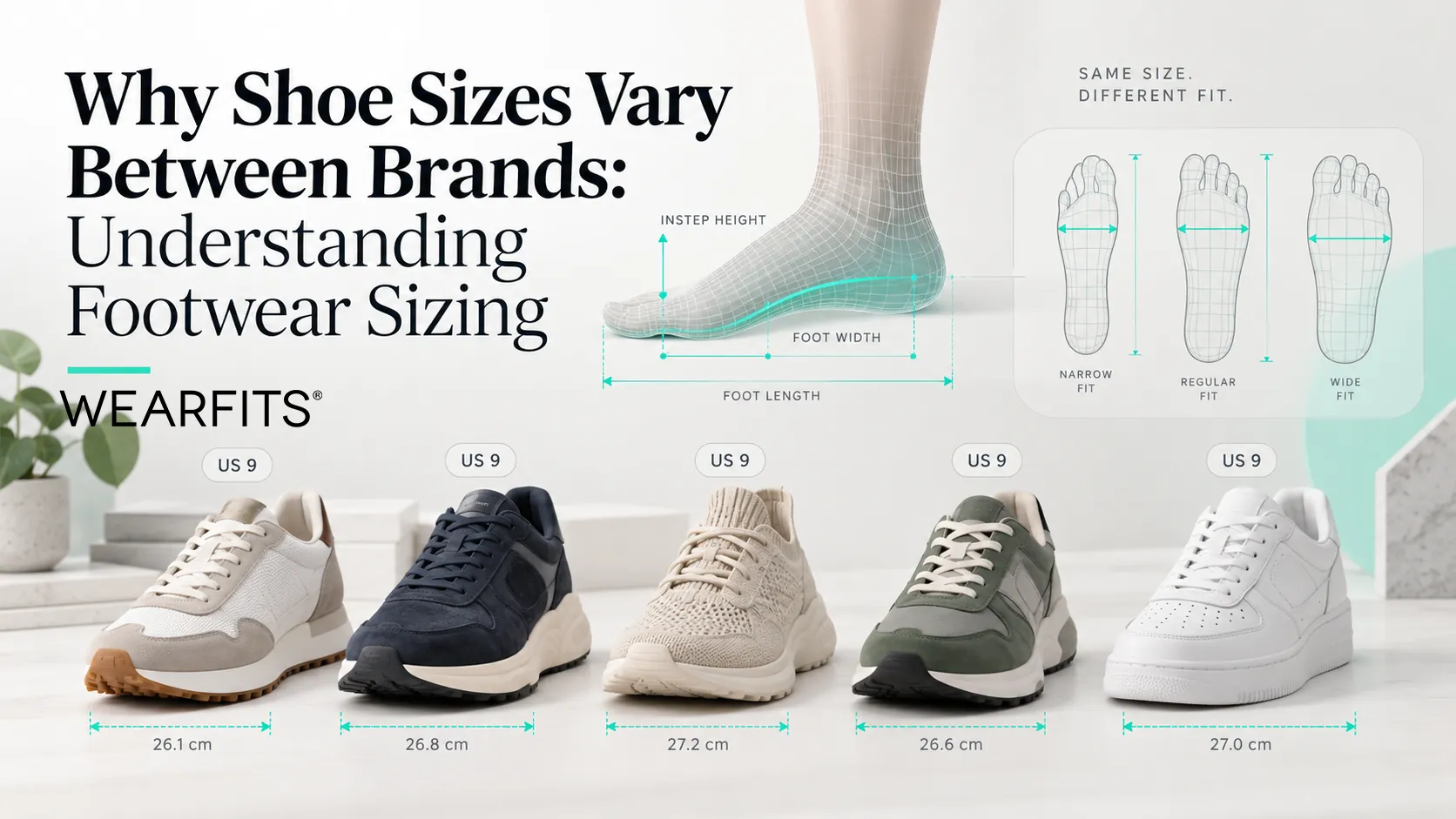
First, sizing varies between brands. Two shoes labeled women's US 8 may differ by as much as 10 mm in internal length.
Second, shoes are developed using different lasts. A last is the three-dimensional form around which a shoe is designed and manufactured. Even within one brand, a running shoe and a court shoe may use completely different last geometries.
Third, customers rarely engage with traditional charts. Fewer than 15% of online shoppers open a static sizing guide.
The result is a familiar e-commerce problem: uncertainty.
The Cost of Ordering Multiple Sizes
When shoppers can't confidently select their size, many choose a workaround known as bracketing.
Instead of buying one pair, they order two or three sizes, try them at home, and return the ones that don't fit.
Research cited in the original industry analysis indicates that 63% of consumers engage in bracketing.
From a customer's perspective, this approach feels practical. From a retailer's perspective, it creates substantial operational costs.
Online footwear return rates commonly range between 18% and 25%, sometimes reaching 29–30% for women's footwear.
Each returned parcel may generate 15-25 in additional costs, including shipping, processing, handling, and inventory depreciation.
The impact extends beyond logistics. Products remain unavailable for resale while moving through the return process, tying up inventory and working capital.
The better solution is to help customers choose the right size before checkout.
3. How WEARFITS Approaches Smarter Footwear Fit
A truly useful footwear recommendation must understand both sides of the equation: the customer's foot and the shoe's internal geometry.
Advanced size and fit technology combines three complementary capabilities:
5D foot measurement → 3D shoe-last matching → personalized AR visualization and fit heatmaps.
Together, these technologies bring digital shopping closer to the confidence of an in-store fitting experience.
Step 1: Understanding the Foot in Five Dimensions
Traditional measurement methods focus on length and width. These values are useful, but insufficient for predicting pressure around the instep, forefoot, or heel.
Modern Edge AI scanning technology can capture five key measurements using a standard smartphone:
- Foot length, measured from heel to toe
- Forefoot width across the metatarsals
- Instep height and midfoot volume
- Arch height and overall profile
- Ball girth, representing forefoot circumference
The scanning process can take less than 60 seconds, with advanced solutions targeting sub-2 mm measurement accuracy and on-device processing latency below 50 milliseconds.
The resulting 5D profile offers a much richer understanding of individual foot anatomy.
Instead of assuming that every EU 38 customer has the same foot shape, retailers can begin working with personalized measurements.
Step 2: Matching Foot Geometry With the Shoe Last
The next stage involves the shoe itself.
By using detailed 3D last specifications across product SKUs and sizes, a fit engine can compare the customer's foot dimensions with the available internal space.
Crucially, the algorithm applies different tolerances depending on the footwear category.
For sneakers, a length allowance of approximately +4–6 mm can be considered alongside more flexible forefoot volume requirements.
For court shoes, the margin may narrow to +2–3 mm, with greater attention paid to instep pressure and heel retention.
For high heels, the calculation becomes more complex. The system must account for heel pitch, forward foot displacement, and the relationship between metatarsal expansion and the shoe's ball girth.
This category-aware approach is essential because a measurement that works comfortably in a sneaker may produce a poor fit in a stiletto.
Step 3: Making Fit Easy to Understand
Accurate measurements are valuable, but they become even more useful when translated into information shoppers can immediately understand.
This is where augmented reality and personalized fit heatmaps come together.
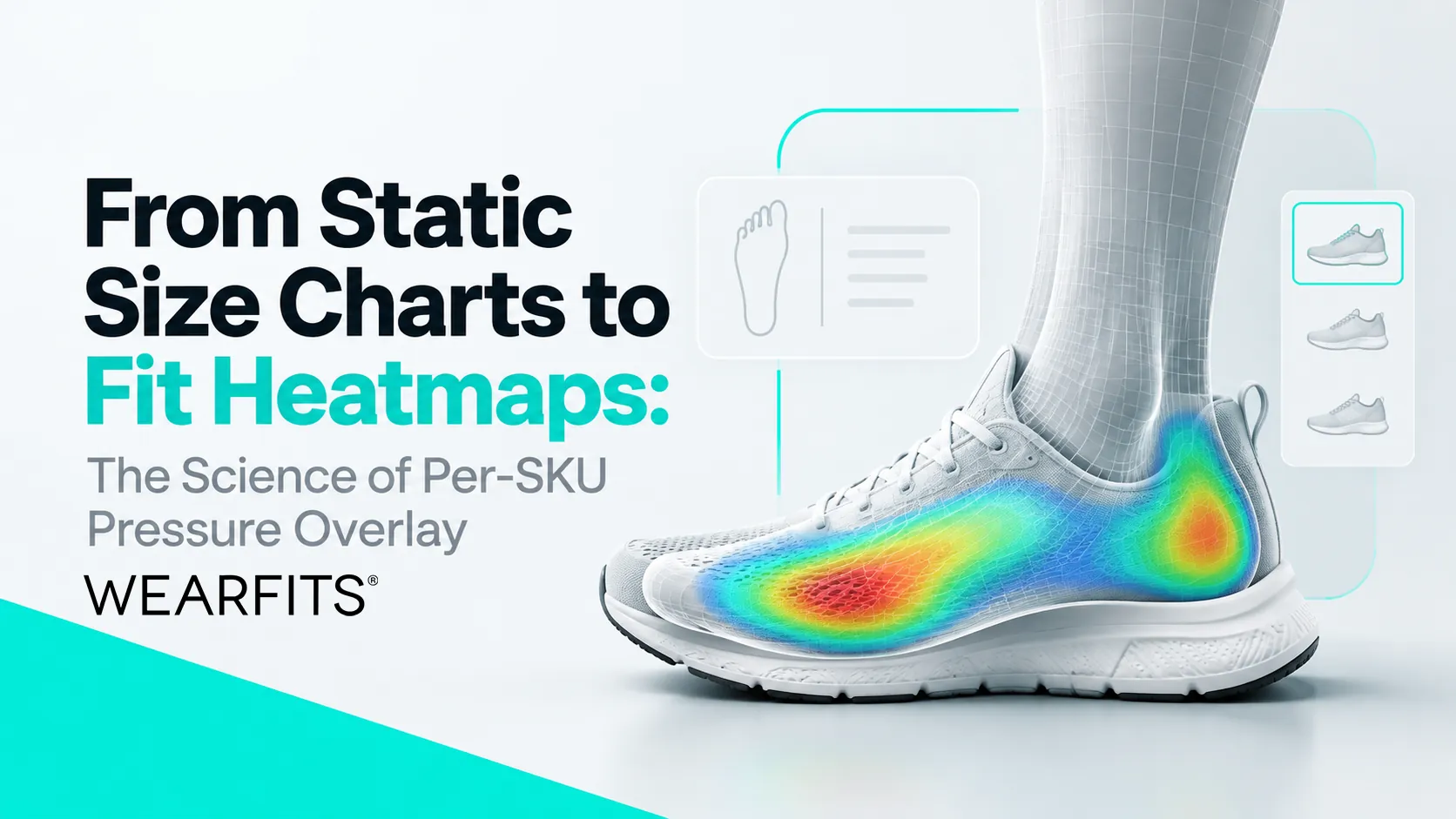
A virtual try-on experience can display a realistic 3D representation of the footwear while illustrating areas of potential pressure or comfort.
A simple color system makes the results intuitive:
- Teal or green: Comfortable fit and appropriate space
- Amber or coral: Potential tightness around the forefoot or instep
- Red: Significant geometric mismatch and increased fit risk
Imagine comparing EU sizes 38 and 38.5 and watching the pressure visualization change instantly.
Instead of relying on guesswork, the customer can see which option offers a better fit and receive a clear "Fit Confirmed" recommendation.
At WEARFITS, we see this connection between personalized sizing and visual product interaction as an important step toward more confident online shopping.
4. What Better Fit Technology Means for E-Commerce Performance
Improving the footwear shopping experience isn't only about customer comfort. It can also influence some of the most important retail performance indicators.
Industry benchmarks and reported outcomes illustrate the potential of combining intelligent sizing recommendations with AR try-on.
These figures represent industry benchmarks and reported technology outcomes rather than guaranteed results for every retailer.
Fewer Returns, Lower Costs
Reducing size-related returns by approximately 20% can create meaningful savings.
With reverse logistics expenses of 25 per parcel, every avoided return helps protect margins.
It also reduces the time inventory spends outside the available sales pool.
Stronger Product Page Conversion
Sizing uncertainty often appears at the worst possible moment: just before adding an item to the cart.
A personalized recommendation can help remove that hesitation.
Reported conversion improvements of approximately 30% on technology-enabled SKUs demonstrate the commercial potential of making fit decisions easier.
Less Bracketing
When customers trust the recommendation, ordering multiple sizes becomes less necessary.
A reduction of around 33% in bracketing can improve both operational efficiency and inventory availability.
Different Categories, Different Results
Not every footwear segment produces identical results.
Lifestyle sneakers and court shoes may see particularly strong percentage reductions in returns, around 20–25%.
Performance running shoes, meanwhile, may generate larger absolute financial savings because of higher order volumes.
This reinforces the importance of evaluating fit technology at category and SKU level rather than relying on a single storewide metric.
5. A Practical Roadmap for Footwear Retailers
Adopting smarter sizing doesn't require every product to be transformed at once.
A focused implementation strategy can help e-commerce teams prioritize the opportunities with the greatest commercial potential.
Start Where Returns Hurt Most
Begin by reviewing the products generating the highest number of fit-related returns.
A useful starting point is to identify the top 50 SKUs responsible for approximately 80% of sizing returns.
These frequently include structured court shoes, heels, and fitted boots.
Concentrating efforts on high-impact products allows teams to evaluate results before expanding across the catalog.
Place Fit Guidance Where Customers Need It
Even excellent technology has limited value if shoppers cannot find it.
The most effective location for a "Try-On & Fit" feature is within the product page's primary buying area, ideally next to or directly below the size selector.
Reported engagement can reach 55–65% when the feature is clearly visible, compared with less than 15% when sizing tools are hidden inside description tabs.
Visibility makes a measurable difference.
Make Measurement a One-Time Experience
Customers should not need to repeat the same process for every product.
A simple onboarding experience can position the approximately 60-second foot scan as a one-time step that enables personalized recommendations throughout the brand's catalog.
With clear communication, scan completion rates can exceed 70%.
The message should be straightforward: measure once, shop with greater confidence.
Connect Fit Confidence With Return Policies
Once retailers provide reliable fit recommendations and visual try-on tools, they may also have more flexibility to address excessive bracketing.
For example, brands can consider policies or fees related to duplicate-size returns, provided the customer experience remains transparent and fair.
The goal isn't to make returns difficult. It's to reduce the need for unnecessary returns in the first place.
6. Why Category-Specific Fit Is the Future
Footwear sits at the intersection of fashion, comfort, engineering, and individual anatomy.
Yet much of online retail still treats sizing as a simple conversion between numbers.
The difference between a flexible sneaker and a structured high heel shows why this approach has limitations.
A successful digital fitting experience should understand the unique construction of each shoe, account for individual foot measurements, and communicate the recommendation in a way that feels effortless.
This is the direction we believe footwear e-commerce should take at WEARFITS.
By bringing together 5D foot analysis, 3D last geometry, category-specific fit algorithms, and augmented reality, brands can move beyond generic recommendations toward a more personalized shopping experience.
For customers, that means less uncertainty and a better chance of finding shoes they genuinely enjoy wearing.
For retailers, it means fewer size-related returns, more efficient inventory management, stronger conversion opportunities, and greater customer confidence.
Because the right shoe size isn't simply the number printed on the box. It's how that particular shoe fits that particular foot.
WEARFITS — Bringing personalized fit and immersive shopping experiences closer together.
Related posts